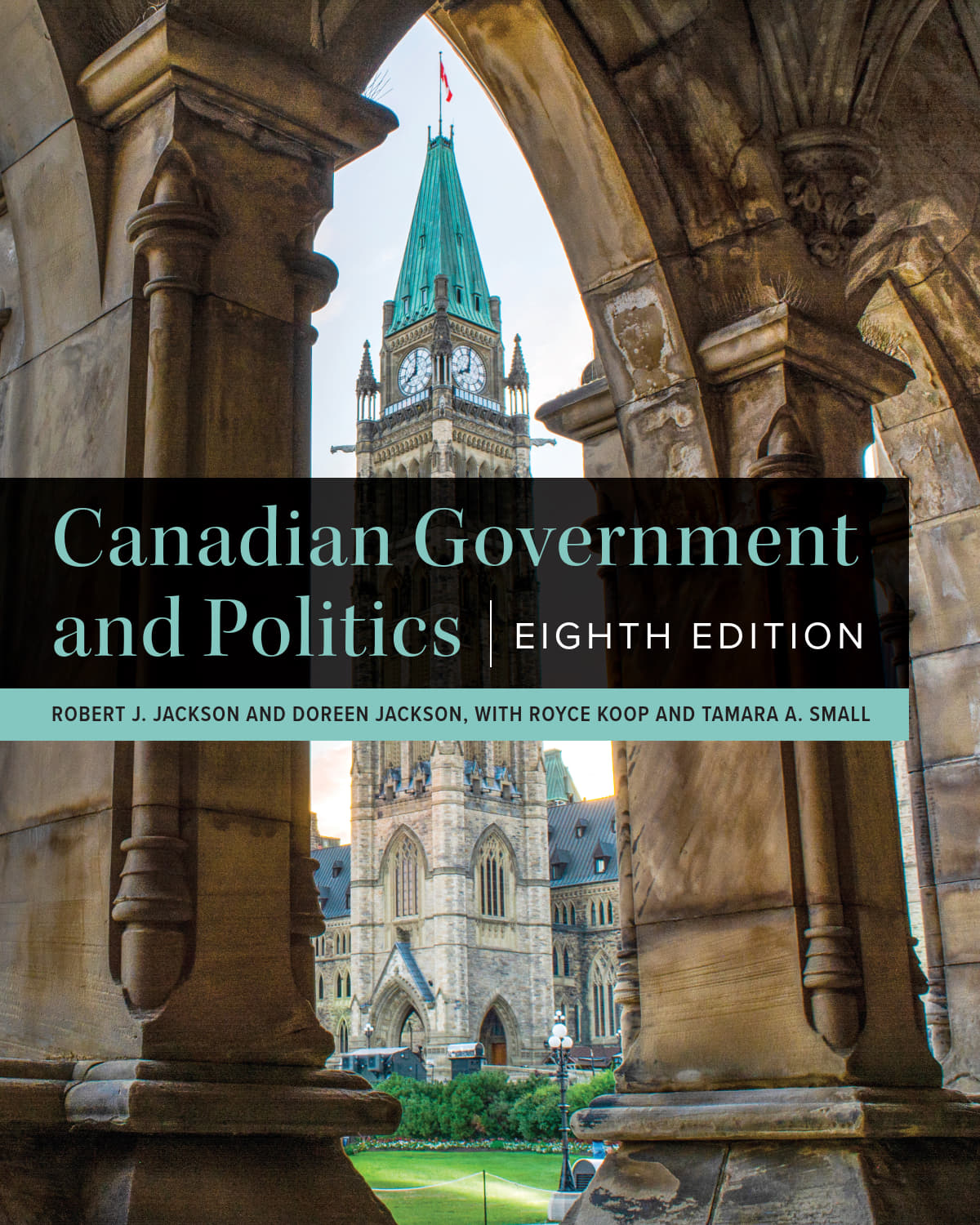
Canadian Government and Politics – Eighth Edition
  • Publication Date: April 30, 2026
  • ISBN: 9781554816989 / 155481698X
  • 456 pages; 8" x 10"

Price for your region

Broadview eBooks are available on a variety of platforms. To learn more, please visit our eBook information page.

Note on pricing.

Ebook will also be available for purchase upon publication.

Request Exam Copy

Examination copy policy

Availability: Worldwide

Canadian Government and Politics – Eighth Edition

  • Publication Date: April 30, 2026
  • ISBN: 9781554816989 / 155481698X
  • 456 pages; 8" x 10"

Canadian Government and Politics delivers an up-to-date and concise introduction to Canada’s political institutions, processes, and issues. The text integrates theory, history, Census data, and current affairs to give students an orderly picture of the wide-ranging landscape of Canadian government and politics. This eighth edition includes coverage and analysis of the 2025 general election, as well as a preview of the new Canadian government. It also adds exciting material on Canada’s cultural landscape, institutions, and policies, along with a full chapter on Indigenous Peoples in Canada.

Other chapters examine the executive, legislative, and judicial branches of government, the electoral system, bureaucracy, nationalism and regionalism, foreign policy, and much more. The authors provide trenchant coverage of many key issues of concern to Canadians, including Indigenous justice and rights, regionalism, housing policies, and demographic representation. These topics are addressed by way of fair-minded, impartial discussions, aimed to foster an optimistic perspective on Canadian politics that will encourage critical thinking and active citizenship.

Comments

“This textbook offers undergraduate students an ideal introduction to Canadian politics, providing excellent coverage on institutional arrangements, processes, and policy issues. Subject analysis is comprehensive and relevant whilst remaining both focused and accessible. The text is well organized with clear objectives, definitions, and suggested discussion questions provided throughout. The eighth edition is sure to spark engaged seminar conversations, having been updated to expand coverage of important contemporary topics including Western alienation, indigenous child welfare, housing policy, trade relations, and military spending.” — Jan Hancock, Cape Breton University

“A classic text gets a timely and comprehensive update that combines up-to-date analysis of recent events, such as the 2025 election and the re-emergence of Western discontent, with thoughtful historical context and analysis that works to deepen the students’ understanding of both. Used effectively, this new edition can help students navigate a political world that is increasingly fractured and fractious.” — Tom McIntosh, University of Regina

“As Canada’s place in the world shifts and heaves in uncertain times, students must have a strong foundation in the people, places, and institutions that shaped our country’s political development and that explain current dynamics of conflict and change. Accessible, comprehensive, and up to date, this textbook is required reading for students who are curious about Canada and all of its political complexities.” — Anna Esselment, University of Waterloo

“Comprehensive? Yes. Accessible? Absolutely. Comprehendible? Completely. Canadian Government and Politics is readable, engaging, and inviting. Students will appreciate and learn from the depth and breadth of coverage and the insights that are offered page after page. Ideas, institutions and actors are well delineated. Theoretical concepts are brought to life. Real life examples of how Canadian government and politics unfold are presented. There could scarcely be a time when it is more necessary for students to understand the complexities of governing Canada. This text helps immeasurably in achieving that goal.” — Greg Inwood, Toronto Metropolitan University

“Equal parts textbook and extended conversation about our political system, Canadian Government and Politics moves seamlessly between the big concepts and what we witness daily, offering a clear, logical picture of Canada’s political operations, from its origins to today. Real-world examples, end-of-chapter discussion questions, marginal key terms, and recommended readings round out a textbook that will bring together students and instructors to jointly explore Canada’s political development.” — Yale D. Belanger, University of Lethbridge

Chapter 1

  • The Game of Politics: Concepts and Institutions

Chapter 2

  • The Context and Ideas of Government: Cohesion, Division, and Identity

Chapter 3

  • The Constitutional Framework: Rules for Government and the Political Game

Chapter 4

  • Contested Federalism: The Division of Powers, Financial Resources, and Regionalism

Chapter 5

  • Nationalism and Regionalism: Territorial Identities in Québec and the West

Chapter 6

  • Indigenous Peoples in Canada: The Search for Equality and Justice

Chapter 7

  • The Executive: Ceremony and Leadership

Chapter 8

  • Parliament: The Public Arena of Politics

Chapter 9

  • Public Administration and Public Policy: Democracy, Bureaucracy, and the Public Service

Chapter 10

  • The Administration of Justice and Human Rights: Courts, Charter Cases, Police, Prisons, Public Security, and Foreign Interference

Chapter 11

  • Parties and Interest Groups: Teams in the Game

Chapter 12

  • Elections and Political Behaviour: The Contests and the Messengers

Chapter 13

  • Canadian Global Policy: Opportunities and Sacrifices

Robert J. Jackson is Distinguished Professor of Political Science at Carleton University and Fletcher Jones Professor of Government at the University of Redlands. He has been employed in various senior government positions, including as Senior Policy Advisor to four Canadian prime ministers. He has published over 40 books in Canadian politics, comparative politics, and international relations.

Doreen Jackson is a writer and consultant. She has co-authored 23 books in Canadian, comparative, and world politics, including a number of widely adopted textbooks.

Royce Koop is Professor of Political Science and Coordinator of the Canadian Studies program at the University of Manitoba. He has authored or edited several books, including Grassroots Liberals: Organizing for Local and National Politics (UBC Press, 2012), which won the 2014 Seymour Martin Lipset Best Book Award.

Tamara A. Small is Professor of Political Science at the University of Guelph. She is co-author of Fighting for Votes: Parties, the Media and Voters in an Ontario Election (UBC Press, 2015) and co-editor of several books, including Digital Politics in Canada: Promises and Realities (University of Toronto Press, 2020), Political Communication in Canada: Meet the Press and Tweet the Rest (UBC Press, 2015), and Mind the Gaps: Canadian Perspectives on Gender and Politics (Fernwood Publishing, 2013).

CONTENT:

  • • Excellent introduction to the executive, legislative, and judicial branches of government
  • • Discussions of provocative social and cultural issues throughout help students to draw connections between the everyday workings of government and their own lives
  • • Coverage of the campaigns, results, and potential impact of the 2025 general election
  • • Incorporates the newest available data from the Census and other government sources
  • • Discussion of new and continuing issues in domestic and foreign policy
  • • Coverage of political issues of interest to young people, such as gender identity, political personalities, election issues, Indigenous Peoples’ rights, pipelines, and Canada–US relations
  • • This 8th edition offers up-to-date discussions of Western alienation, Indigenous child welfare and justice, demographic representation in government, housing policy, racial justice, third-party intervention, and more

PEDAGOGY:

  • • Learning Objectives appear at the beginning of each chapter, foregrounding a plan for reading and studying the subsequent material;
  • • Key Terms appear in bold type in the running text, with definitions located in the margins;
  • • “Close-Up” Boxes provide topical issues and events for interest and discussion;
  • • Illustrations and visual aids (photographs, cartoons, graphs, tables, and interesting close-ups) present information in a varied manner;
  • • Discussion Questions follow each chapter, with an eye toward challenging and motivating students;
  • • A list of Further Reading provides helpful supplementary material;
  • • A Glossary lists key terms with their respective definitions and the page numbers of first reference.