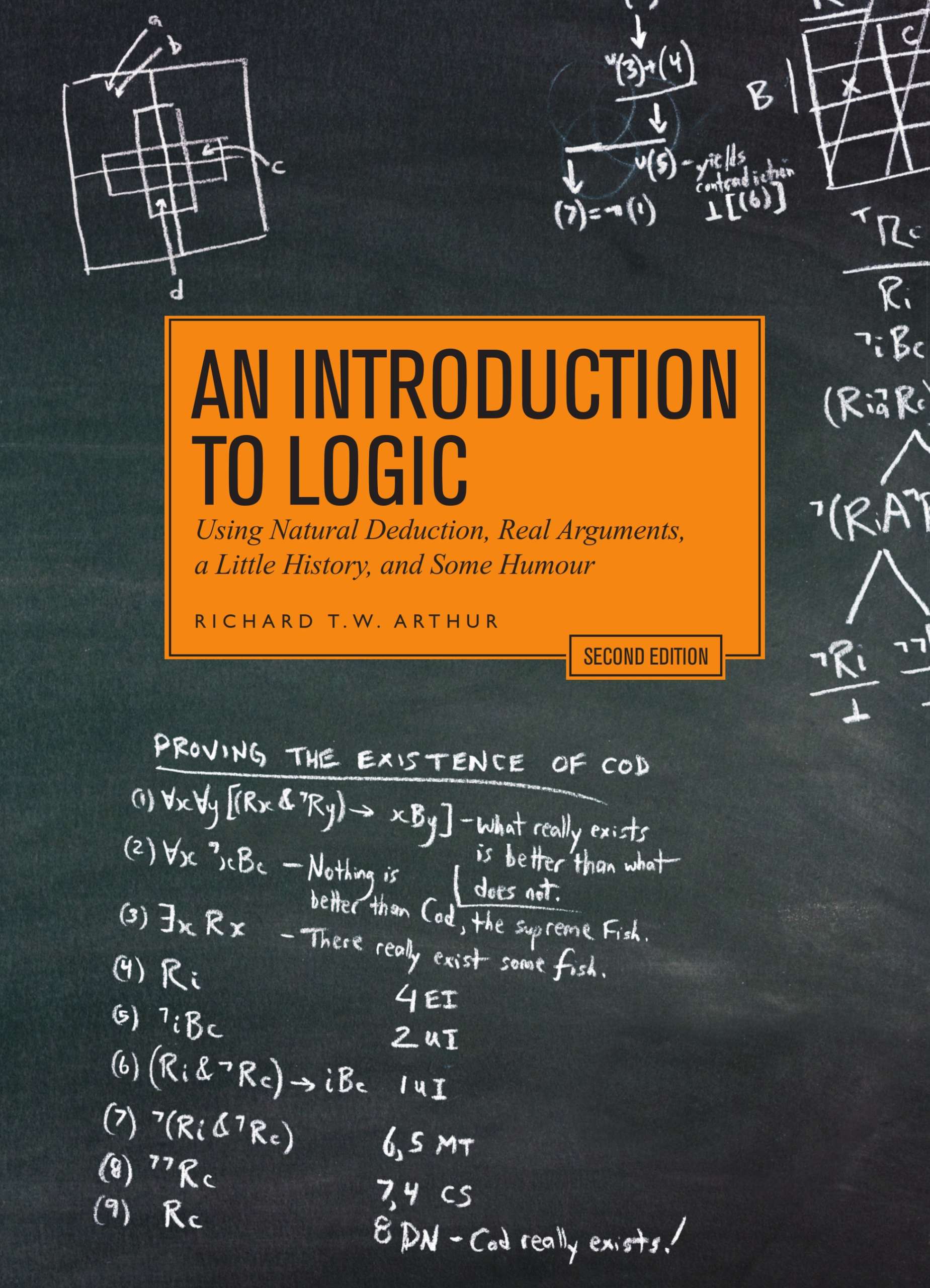
Richard Arthur’s Natural Deduction provides a wide-ranging introduction to logic. In lively and readable prose, Arthur presents a new approach to the study of logic, one that seeks to integrate methods of argument analysis developed in modern “informal logic” with natural deduction techniques. The dry bones of logic are given flesh by unusual attention to the history of the subject, from Pythagoras, the Stoics, and Indian Buddhist logic, through Lewis Carroll, Venn, and Boole, to Russell, Frege, and Monty Python.
Comments
“By and large, this is an excellent addition to the store of introductory logic texts. Arthur’s approach skillfully weaves a thread between formal and informal approaches in such a way that an instructor may emphasize the latter or the former according to preference. Along the way, students practice translating natural language arguments, and in the process learn a bit about the history of philosophy and logic, all of this with an occasional laugh. The result is a text that many instructors will find compelling.” — Nicholas Fillion and Bradley Zurcher, Dialogue
“This excellent text covers all the standard topics and more. Its real strength lies in the clarity and humour of exposition and in the richness of examples and exercises. The illustrations are invariably interesting, since often they are related to current events or the history of philosophy and science or are drawn from Monty Python. The last of these provides several memorable fallacies. Arthur’s Natural Deduction is one of the finest introductions to logic available today.” — James Robert Brown, University of Toronto
“Richard Arthur’s engagingly written Natural Deduction introduces symbolic logic as something that grows naturally out of everyday reasoning. The treatment of category logic in this book, based on an elegant notation created by Lewis Carroll, is original and insightful. I also like Arthur’s suggestion that there is a link between logic and humour: the same mental muscles that enable one to see the point of a joke must also be those that enable one to see a logical connection. His exercises are ingenious and thought-provoking. This unique book is superb and I recommend it highly.” — Kent A. Peacock, University of Lethbridge
Preface for Students
Preface for Instructors
Acknowledgements
PART I: ARGUMENTS
Chapter 1: Arguments
- Introduction
- Identifying Arguments
- Inference Indicators
- Explanations
- Implicit Arguments
- Enthymemes
- Natural Arguments
- Argument and Inference
- Techniques of Diagramming
Chapter 2: Validity
- Validity
- Defining Validity
- Soundness
- Argument Forms and Formal Validity
- Evaluating Natural Arguments
PART II: STATEMENT LOGIC
Chapter 3: Statements and Conditionals
- Statements and Compounds
- Statements
- Compounds
- Statement Operators
- Conditional Statements
- Modus Ponens
- Argument Form and Substitution Instance
- Affirming the Consequent
Chapter 4: Negation
- Symbolizing Negations
- Negations
- Contradictories
- Modus Tollens
- Modus Tollens and Double Negation
- Denying the Antecedent
- Inference and Implication
Chapter 5: Conjunction
- Symbolizing Conjunctions
- Rules of Inference for Conjunction
- Evaluating Extended Arguments
Chapter 6: Disjunction
- Symbolizing Disjunctions
- Rules of Inference for Disjunctions
- Disjunctive Syllogism
- Disjunction
- De Morgan’s Laws
Chapter 7: Conditional Proof
- More on Symbolizing
- Disjunctions in Conditionals
- ‘Unless’
- ‘Otherwise,’ ‘Else’
- More Rules Involving Conditionals
- Conditional Proof and Supposition
- The Hypothetical Syllogism
- Supposition in Natural Argument
Chapter 8: Biconditionals
- Necessary and Sufficient Conditions
- ‘Only if’
- Necessary and Sufficient Conditions
- Biconditionals
- Symbolizing
- Conversational Implicature
- Rules of Inference
Chapter 9: Dilemmas
- Dilemmas
- Natural Dilemmas
Chapter 10: Reductio Arguments
- Reductio ad Absurdum
- Natural Reductio Arguments
Chapter 11: Review and Consolidation
- Rules of Inference
- Rules of Inference and Equivalence Rules
- Proof Strategies
- Derived Rules
Chapter 12: SL as a Formal System
- Rules of Formation
- Symbols, Formulas, and Wffs
- Soundness and Completeness
- Sequents, Theorems, and Axioms
- Sequents and Theorems
- Axioms and the Propositional Calculus
Chapter 13: Truth Tables
- Truth Tables and Statements
- Truth Tables
- Material Implication
- Tautologies, Contradictions, and Contingent Statements
- Logical Equivalence
- Truth Tables and Validity
- The Full Truth Table Method
- Invalid Argument Forms
- The Brief Truth Table Method
Chapter 14: Truth Trees for SL
- Truth Trees
- The Truth Tree Method
- Decomposition Rules
- Statements, Soundness, and Completeness
- Tautologies, Contradictions, and Logical Equivalence
- Soundness and Completeness
PART III: PREDICATE LOGIC
Chapter 15: Syllogistic Logic
- Category Logic
- Aristotle’s Logic
- A-, E-, I-, and O-Statements
- Ambiguous Statements
- Carroll Diagrams
- Carroll’s Diagrams
- Existence and Non-Existence
- Conversion
- Evaluating Validity of Syllogisms
Chapter 16: Universal Quantification
- Universal and Singular Statements
- Universal Quantification
- ‘Only’ and ‘Nothing but’
- Singular Statements and Individual Names
- Rules of Inference: UI and UG
Chapter 17: Existential Quantification
- Particular Statements
- Existential Quantification
- Rules of Inference
- Existential Instantiation
- Existential Generalization
- Proof Strategy
Chapter 18: Advanced Class Logic
- Arguments with More than 3 Predicates
- Carroll Diagrams for 4 or 5 Categories
- Sorites
- Existential Import
- On Giving Universal Statements Existential Import
- Penevalid Arguments
- Non-Emptiness of the UD
Chapter 19: Asyllogistic Arguments
- More on Symbolizing
- Non-Classical Statements
- ‘Any’
- Asyllogistic Proofs: QN
- Predicate Logic as a Formal System
- Symbols, Formulas, and Wffs
- Propositional Functions and Quantifier Scope
Chapter 20: Relational Logic
- The Logic of Relations
- Relations
- Symbolizing Relations
- Nested Quantifiers
- Relational Proofs
- Properties of Binary Relations
- Transitivity, Symmetry, and Reflexivity
- Equivalence Relations
Chapter 21: Logic with Identity
- Identity and Quantity
- Symbolizing Identities and Quantities
- Russell’s Theory of Definite Descriptions
- Inferences Involving Identity
- The Rule of Inference SI
- Properties of Identity
- Ordering Relations
Chapter 22: Relational Arguments
- More on Symbolizing Relational Statements
- A Method for Symbolizing
- Prenex Forms
- Relational Arguments
- Arguments beyond the Scope of Traditional Logic
- Ambiguities and the Quantifier Scope Fallacy
Chapter 23: Truth Trees for PL
- Predicate Logic Truth Trees
- Truth Tree Rules from Statement Logic
- Additional Truth Tree Rules for Quantifications
- Negated Quantifier Decomposition Rules
- Effective Completeness
- Trees for Relational Logic and Identity
- Truth Tree Rules in Relational Logic
- Additional Truth Tree Rules for Identity and Diversity
Chapter 24: Other Logics
- Second Order Logic
- Modal Logic
- Deontic Logic
- Quantum Logic
- Intuitionistic Logic
Appendix 1: The Paradoxes of Material Implication
Appendix 2: A Little History: Consequentiae
Appendix 3: Logic Diagrams
Glossary
Index
Richard T.W. Arthur is Professor of Philosophy at McMaster University.
For a sample chapter of Introduction to Logic, click here. (Opens as a PDF.)
The instructor site hosts almost 700 supplemental questions that can be used in your teaching.
The student companion site includes solutions to the book’s exercises.
An access code to the student website is included with all new copies. If you purchased a used copy or are missing your passcode for this site, you can purchase a code at this link.