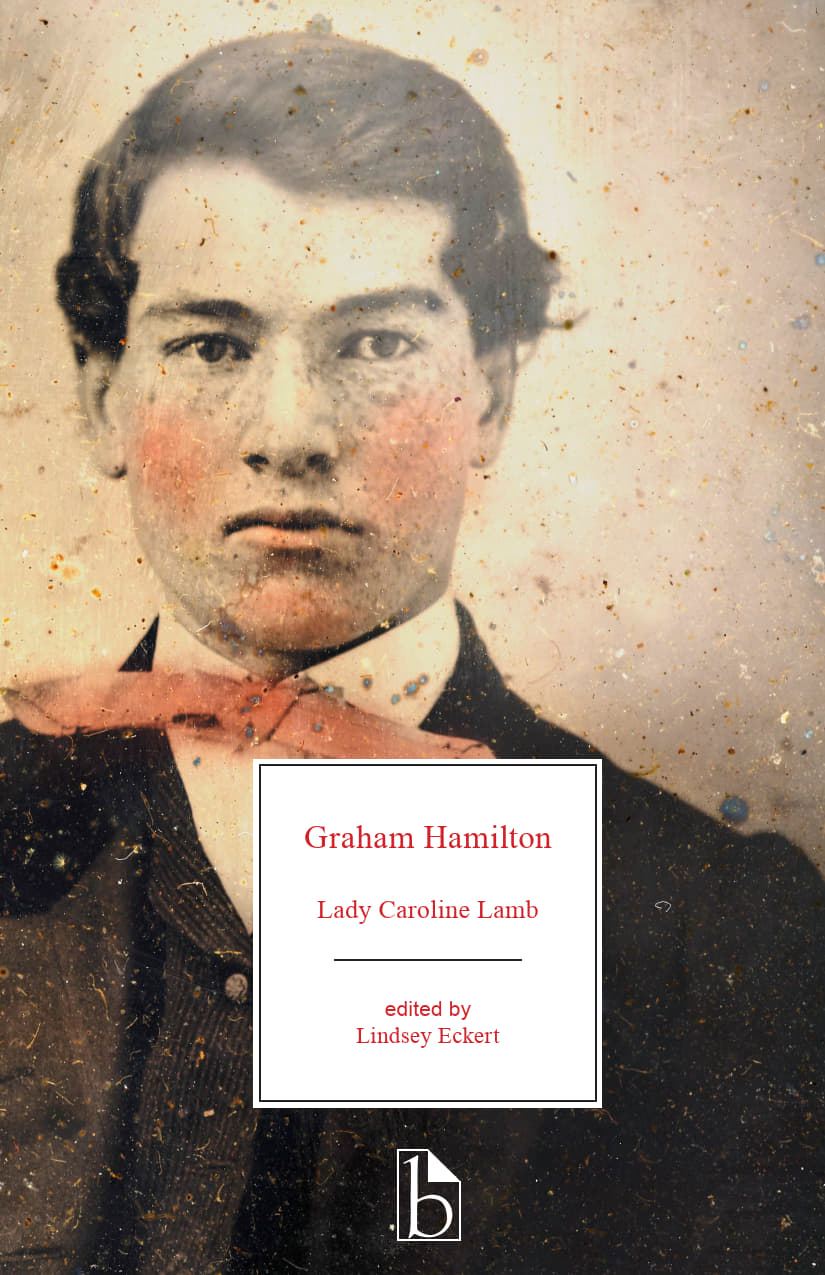
Graham Hamilton
  • Publication Date: January 15, 2027
  • ISBN: 9781554817009 / 1554817005
  • 234 pages; 5½" x 8½"

Price for your region

Note on pricing.

Request Exam Copy

Examination copy policy

Availability: Worldwide

Graham Hamilton

  • Publication Date: January 15, 2027
  • ISBN: 9781554817009 / 1554817005
  • 234 pages; 5½" x 8½"

In her novel Graham Hamilton (1822), Lady Caroline Lamb drew on her privileged life and notorious affairs to produce one of the period’s richest accounts of decadence and debauchery. Tracking her young hero’s journey from humble Scottish origins to London high society to South American exile, Lamb boldly critiques Regency-era extravagance and its global economic underpinning. Graham Hamilton directly engages key tropes of the novel of manners and the marriage plot, but with a sardonic edge entirely Lamb’s own. Though published more than two hundred years ago, Graham Hamilton speaks to current re-evaluations of celebrity culture and the media environments that make and destroy reputations and lives.

This edition’s critical introduction and appendices ground Graham Hamilton in its historical context, showcasing how Lamb adapts conventions of popular literature as well as contentious debates about gender, class, and fame.

Comments

“Lindsey Eckert’s new edition of Graham Hamilton brings Lady Caroline Lamb and her glittering, gritty, tragic world of Regency England to vibrant life. Too long overshadowed by her own celebrity, Lamb emerges as a powerful writer, a trenchant critic of the hypocrisies of the aristocratic class to which she belonged. This edition’s elegant introduction, explanatory notes and contextual materials all help place Graham Hamilton where it belongs, in classrooms and among the important novels of the British Romantic age.” — Andrew Stauffer, The University of Virginia

“This new edition of Graham Hamilton is a triumph for researchers and teachers alike. Lindsey Eckert restores the significance of this novel by placing it in conversation with Caroline Lamb's other writings and the culture of celebrity and scandal that defined her public life. Particularly illuminating is Eckert’s attention to the novel’s generally positive reception, especially in comparison with Glenarvon, and to the precarious position of women caught in the glare of public life at the time. Accompanied by a rich selection of contextual materials and scrupulous editorial notes throughout, this edition is a boon to Caroline Lamb scholarship and the study of Romantic-era celebrity. Its intertextual emphasis makes it a gift to our students and classrooms.” — Omar F. Miranda, University of San Francisco

Appendix A: Graham Hamilton’s Critical Reception

  • 1. From Review of Graham Hamilton, Blackwood’s Edinburgh Magazine (June 1822)
  • 2. From Review of Graham Hamilton, The Monthly Review (October 1822)
  • 3. From Review of Graham Hamilton, The Gentleman’s Magazine (November 1822)
  • 4. From Review of Graham Hamilton, The Monthly Censor (1822)
  • 5. “Graham Hamilton,” The Kaleidoscope; or, Literary and Scientific Mirror (11 June 1822)
  • 6. From “Literature. Graham Hamilton,” The Morning Post (4 July 1822)

Appendix B: Related Works by Lady Caroline Lamb

  • 1. From Lady Caroline Lamb, Preface to Glenarvon, 3rd ed., vol. 1 (1816)
  • 2. From [Lady Caroline Lamb], A New Canto (1819)
  • 3. From [Lady Caroline Lamb], Gordon: A Tale. A Poetical Review of Don Juan (1821)
  • 4. From Lady Caroline Lamb, Ada Reis, A Tale, vol. 3 (1823)
  • 5. Lady Caroline Lamb, “Lines to Harriet Wilson,” Fugitive Pieces and Reminiscences of Lord Byron […] Also Some Original Poetry, Letters and Recollections of Lady Caroline Lamb, by Isaac Nathan (1829)
  • 6. Lady Caroline Lamb, “Thou Would’st Not Do What I Have Done, Sung by Miss Shirreff, Written by Lady Caroline Lamb, Composed by I. Nathan” ([c. 1830–37])

Appendix C: Reputation, Celebrity, and the Press

  • 1. From William Godwin, Things as They Are; or, The Adventures of Caleb Williams, vol. 3 (1794)
  • 2. From Maria Edgeworth, Belinda, 2nd ed., vol. 1 (1802)
  • 3. From Frances Burney, The Wanderer; or, Female Difficulties, vol. 4 (1814)
  • 4. From Lord Byron, Don Juan (1819)

Appendix D: Women, Marriage, and the Marriage Plot

  • 1. From Frances Burney, Evelina, or, A Young Lady’s Entrance into the World, vol. 3 (1778)
  • 2. From Mary Wollstonecraft, The Wrongs of Woman; or, Maria: A Fragment, vol. 2 of The Posthumous Works of the Author of A Vindication of the Rights of Woman, edited by William Godwin (1798)
  • 3. From [Georgiana, Duchess of Devonshire], The Sylph; A Novel, 2nd ed., vol. 1 (1779)
  • 4. From “On the Duties of Matrimonial Life,” The Female Instructor; or, Young Woman’s Companion ([1811?])

Appendix E: Lady Caroline Lamb’s Nineteenth-Century Reputation

  • 1. From [Elizabeth Thomas], Purity of Heart, or, The Ancient Costume, A Tale, in One Volume, Addressed to the Author of Glenarvon, 2nd ed. (1817)
  • 2. From “Biographical Sketch of Lady Caroline Lamb (with a Portrait),” The New Monthly Magazine and Universal Register (May 1819)
  • 3. Elizabeth Isabella Spence, “M.S. Lines on Lady Caroline Lamb” (20 November 1825), The Album of Anna Birkbeck ([c. 1825–62])
  • 4. From X.X., “Biography. Lady Caroline Lamb,” The Literary Gazette; and Journal of Belles Lettres, Arts, Sciences, etc. (16 February 1828)
  • 5. From “Recollections of Lady Caroline Lamb,” La Belle Assemblée, or Court and Fashionable Magazine (March 1828)
  • 6. From Grace Wharton and Philip Wharton, “Lady Caroline Lamb,” The Queens of Society, vol. 2 ([1860])

Lindsey Eckert is the Timothy Gannon Associate Professor of English at Florida State University.