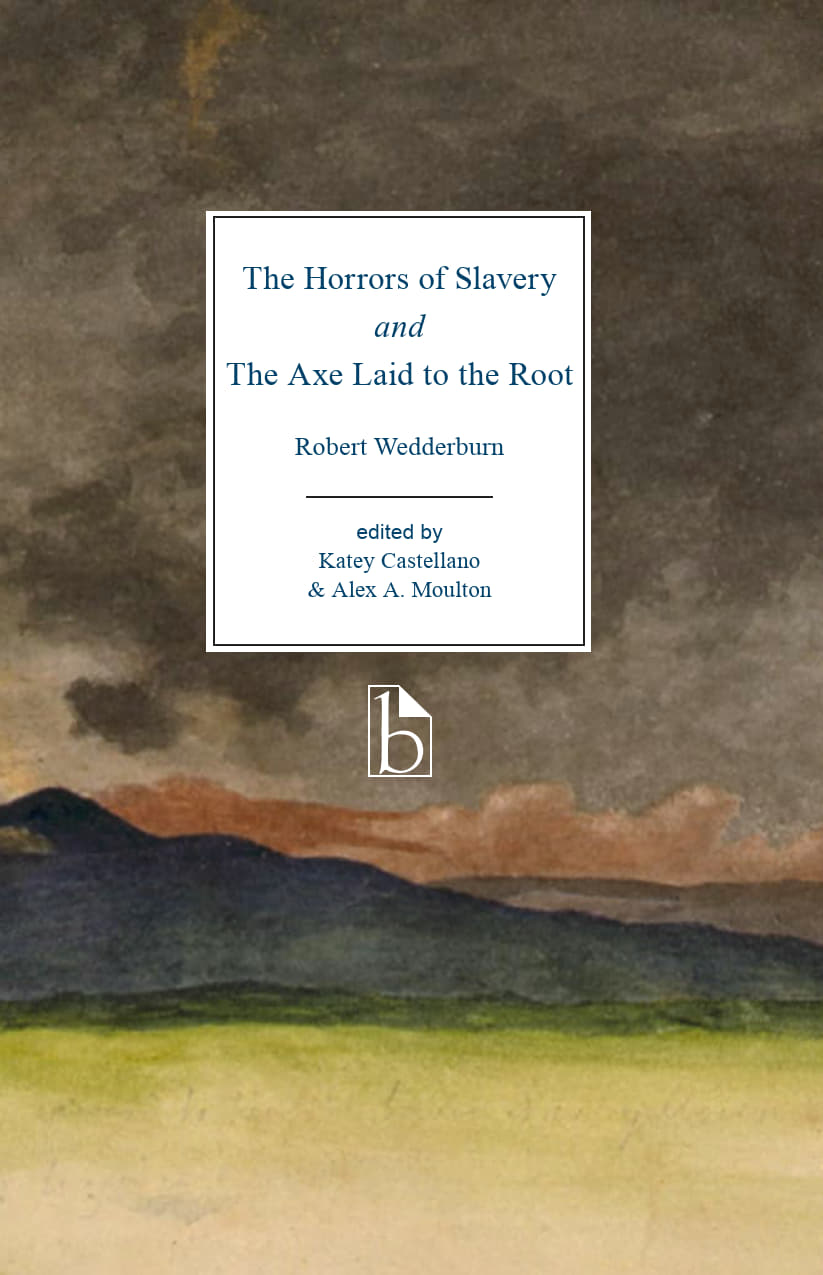
Robert Wedderburn was born under the lash in mid-eighteenth-century Jamaican plantation society, the illegitimate child of a plantation owner and an enslaved Black woman. Despite the circumstances of his birth, Wedderburn would become one of the foremost abolitionists of the nineteenth century. Migrating to Great Britain as a young man, he established himself as a radical preacher and political critic in London. This volume reprints his life narrative, The Horrors of Slavery and his fiery periodical, The Axe Laid to the Root. Taken together, Wedderburn’s writing and his public life provide a vision of transatlantic liberation and multiracial working-class agitation for social change.
The introduction and notes in this new edition uniquely situate Wedderburn and his work within a lively intersection of his Black Atlantic, Caribbean, and British contexts. This edition illustrates Wedderburn’s enduring relevance for scholarship in Atlantic studies, Black studies, political theology, racial capitalism, and Romanticism.
List of Illustrations
Acknowledgements
Introduction
Robert Wedderburn: A Brief Chronology
A Note on the Texts
The Horrors of Slavery
The Axe Laid to the Root, or A Fatal Blow to Oppressors
Appendix A: Writings and Representations of Robert Wedderburn
- 1. George Cruikshank, A Peep into the City of London Tavern, by an Irish Amateur (1817)
- 2. From Robert Wedderburn, The Forlorn Hope, or A Call to the Supine, to Rouse from Indolence and Assert Public Rights (1817)
- 3. Handbills for Wedderburn’s Debates of 1819
- a. “Can It Be Murder to Kill a Tyrant?” (9 August 1819)
- b. “Vengeance Awaits the Guilty” (16 August 1819)
- c. “Murder, or No Murder!!” (13 September 1819)
- 4. Home Office Spy Reports (1817–19)
- a. HO 42/158 [15 January 1817], pp. 229–30
- b. HO 42/195 [9 August 1819], pp. 242–45
- c. HO 42/191 [10 August 1819], pp. 18–19
- d. HO 42/191 [10 August 1819], p. 61
- e. HO 42/198 [1 November 1819], pp. 490–93
- 5. Wedderburn’s Trial and Prison Sentence for Blasphemous Libel
- a. From The Trial of the Rev. Robt. Wedderburn, (a Dissenting Minister of the Unitarian Persuasion,) for Blasphemy (1820)
- b. From Richard Carlile, “To the Christian Judge Bailey,” The Republican (3 March [May] 1822)
- 6. Robert Wedderburn, “The Holy Liturgy,” The Lion (21 March 1828)
- 7. From Robert Wedderburn, An Address to the Right Honourable Lord Brougham and Vaux, Chancellor of Great Britain, by the Descendant of a Negro (1831).
Appendix B: The Haitian Revolution
- 1. From Bryan Edwards, An Historical Survey of the French Colony in the Island of St. Domingo (1797)
- 2. Proclamation of Dessalines, Christophe, and Clervaux, Chiefs of St. Domingo (29 November 1803)
- 3. Jean-Jacques Dessalines, Liberty or Death!—Native Army (1 January 1804)
- 4. Jean-Jacques Dessalines, Liberty or Death! A Proclamation (28 April 1804)
Appendix C: Black Geographies in the Caribbean
- 1. From Benjamin Moseley, A Treatise on Sugar (1799)
- 2. Etching of Trelawney Town, the Chief Residence of the Maroons, from The History, Civil and Commercial, of the British Colonies in the West Indies by Bryan Edwards (1801).
- 3. From R.C. Dallas, The History of the Maroons (1803)
- 4. From Matthew Gregory Lewis, Journal of a West India Proprietor (1818, 1834)
- 5. From Mary Prince, The History of Mary Prince (1831)
Appendix D: Writers of the Black Atlantic
- 1. Phillis Wheatley, “To the Right Honourable William, Earl of Dartmouth” (1772)
- 2. Phillis Wheatley, Letter to Reverend Samson Occom (11 March 1774)
- 3. From Ottobah Cugoano, Thoughts and Sentiments on the Evil and Wicked Traffic of the Slavery and Commerce of the Human Species (1787)
- 4. From Olaudah Equiano, The Interesting Narrative of the Life of Olaudah Equiano (1789)
- 5. From Frederick Douglass, Narrative of the Life of Frederick Douglass, an American Slave (1845)
- 6. From Mary Seacole, Wonderful Adventures of Mrs. Seacole in Many Lands (1857)
Appendix E: British Working-Class Print Cultures
- 1. Broadside: “Desponding Negro” (1793)
- 2. Thomas Spence, The Marine Republic (1794), from The Giant Killer, or Anti-Landlord (1814)
- 3. From Thomas Spence, The Rights of Infants (1797)
- 4. From The Address and Regulations of the Society of Spencean Philanthropists (1815)
- 5. Broadside Advertisement: “Just Published, price 3d. Address of the Society of Christian Philanthropists” (1817)
- 6. From William Cobbett, “To Mr. Benbow,” The Political Register (29 November 1817)
Appendix F: List of Emendations to Wedderburn’s Texts
Works Cited and Recommended Reading
Katey Castellano is Professor of English at James Madison University. Alex Moulton is Assistant Professor of Geography and Environmental Science at Hunter College and CUNY Graduate Center.