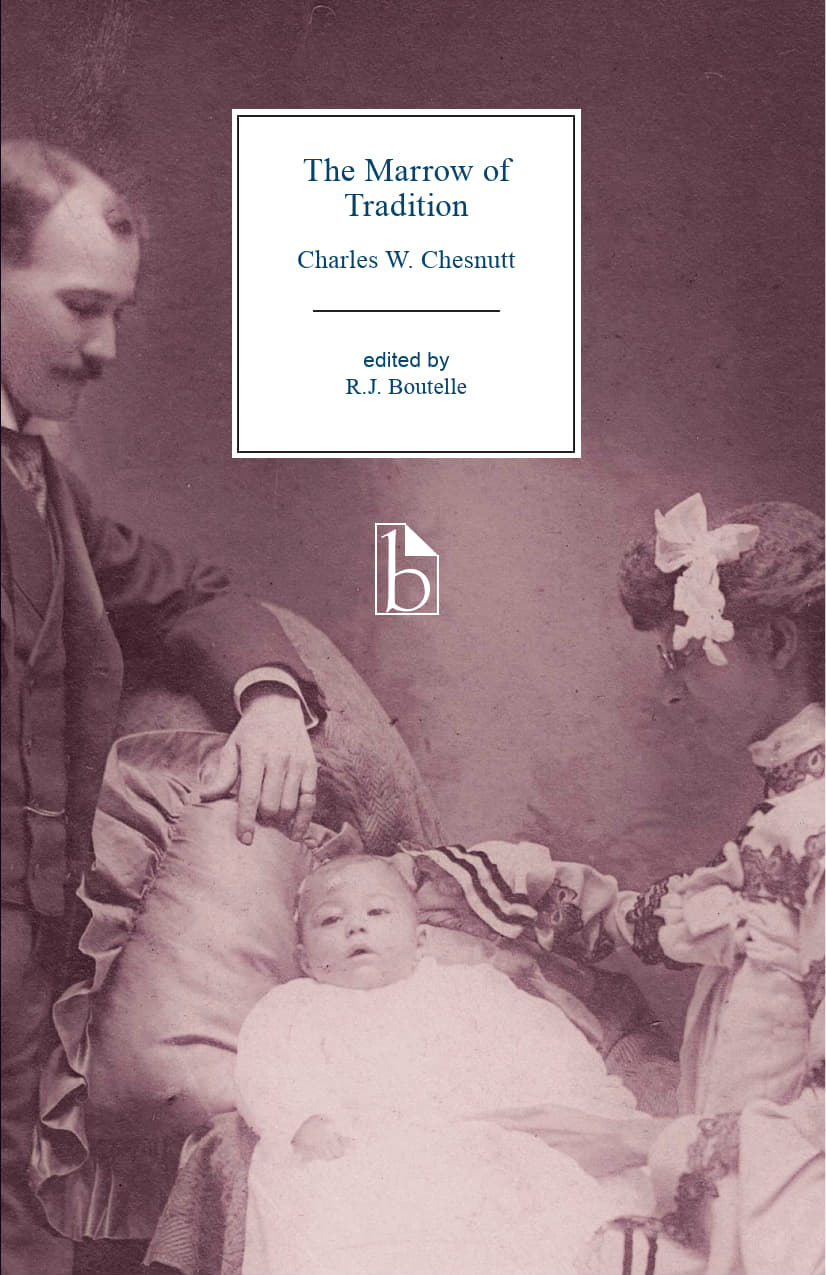
The Marrow of Tradition
  • Publication Date: November 15, 2026
  • ISBN: 9781554816637 / 1554816637
  • 396 pages; 5½" x 8½"

Price for your region

Note on pricing.

Ebook will also be available for purchase upon publication.

Request Exam Copy

Examination copy policy

Availability: Worldwide

The Marrow of Tradition

  • Publication Date: November 15, 2026
  • ISBN: 9781554816637 / 1554816637
  • 396 pages; 5½" x 8½"

An emotional tour de force, Charles W. Chesnutt’s The Marrow of Tradition (1901) unfolds against the backdrop of the only successful coup d’état in US history—the 1898 Wilmington Massacre. The novel combines domestic dramas, political scheming, and social commentary as it documents white supremacists’ violent “redemption” of a majority Black city. By following two interrelated families—the white Carterets and the Black Millers—through these harrowing events, The Marrow of Tradition offers intimate insights into the complexities of life on the color line. Equal parts comedic, romantic, political, and tragic, the novel probes the depths and artifice of race relations in the United States.

This Broadview Edition provides thorough annotation, an up-to-date introduction, and supplementary documents on the novel’s composition, reception, and historical context.

Comments

“An excellent edition of Charles W. Chesnutt’s great novel of 1901, which is especially useful for anyone interested in reading The Marrow of Tradition in its broad historical and cultural contexts. R.J. Boutelle’s introduction is eloquent and informative. The primary materials from the Wilmington massacre of 1898 in particular help us to better understand Chesnutt’s aims in the novel—and are chilling.” — Robert S. Levine, Distinguished University Professor, University of Maryland

“Chesnutt wrote The Marrow of Tradition in the immediate aftermath of the 1898 Wilmington massacre, and the novel still carries the heat of that proximity—a domestic melodrama that darkens into an account of a city’s government overthrown by armed white supremacists. Boutelle’s introduction is finely pitched, laying out Chesnutt’s biography and the wreckage of Reconstruction with clarity, while his annotations work well to untangle references or period terms exactly where a reader might stumble. The Appendices gather and hone primary voices instead of paraphrasing them, setting Ida B. Wells’s accounting of lynching against Alfred Moore Waddell’s own justification of the coup he led, for example, to help readers confront the distance between what happened and what the perpetrators claimed had happened. Few American novels detonate with this much force, and this edition finally gives Marrow the classroom life it has long deserved.” — Susanna Ashton, Clemson University

“Boutelle has produced a rich and deeply researched edition of The Marrow of Tradition that will prove indispensable for students and scholars alike. The wealth of primary and secondary materials he has selected to accompany the novel along with Boutelle’s own keen insights into Chesnutt’s writings brilliantly illuminate a complex novel whose importance has only continued to grow in the twenty-first century. As Boutelle argues, Marrow is a novel not just for Chesnutt’s times but also for ours. I look forward to using this worthy edition in my courses. We needed this book.” — Jennifer James, George Washington University

Acknowledgements

Introduction

Charles W. Chesnutt: A Brief Chronology

A Note on the Text

Family Tree and Wellington Characters

The Marrow of Tradition

Appendix A: Composition and Reception

  • 1. Charles Chesnutt, “Plot Notes” (1900)
  • 2. Charles Chesnutt, Letter to Walter Hines Page (11 November 1898)
  • 3. William Dean Howells, “A Psychological Counter-Current in Recent Fiction,” North American Review (December 1901)
  • 4. T. Thomas Fortune, “The Marrow of Tradition: A Review,” The Colored American (30 November 1901)
  • 5. “The ‘Wellington’ Revolution,” The Wilmington Messenger (10 January 1902)
  • 6. “The Marrow of Tradition,” The Cleveland Gazette (16 May 1903)

Appendix B: Black Progress and White Backlash in the Post-Reconstruction Era

  • 1. From Henry McNeal Turner, The Barbarous Decision of the United States Supreme Court (1893)
  • 2. From T. Thomas Fortune, Black and White: Land, Labor, and Politics in the South (1884)
  • 3. Booker T. Washington, “Address by Booker T. Washington” (1896)
  • 4. From W.E.B. Du Bois, “The Talented Tenth” (1903)

Appendix C: Cakewalks, Caricatures, and Black Responses to Dangerous Stereotypes

  • 1. Bruce Grit [John Edward Bruce], “The Character of Bruce,” The Colored American (26 March 1898)
  • 2. From James Weldon Johnson, Autobiography of an Ex-Colored Man (1912)
  • 3. From Thomas Nelson Page, Social Life in Old Virginia Before the War (1897)
  • 4. “We Reap as We Sow,” The News and Observer (21 January 1898)
  • 5. From Ida B. Wells, The Red Record (1895)

Appendix D: The Roots of Black Resistance and White Terrorism in North Carolina

  • 1. From David Walker, Appeal to the Coloured Citizens of the World (1829)
  • 2. From Harriet Jacobs, Incidents in the Life of a Slave Girl (1861)

Appendix E: The White Supremacy Campaign of 1898

  • 1. From Alexander Manly, “Mrs. Felton’s Speech,” The Daily Record (18 August 1898)
  • 2. “Resolutions,” The Daily Record (20 October 1898)
  • 3. “Remarkable Meeting,” The Wilmington Messenger (10 November 1898)
  • 4. The Committee of Colored Citizens to Hon. A.M. Waddell (10 November 1898)

Appendix F: The Contested History of the Wilmington Massacre

  • 1. “Findings,” 1898 Wilmington Race Riot Report (31 May 2006)
  • 2. Alfred Moore Waddell, “The Story of the Wilmington, N.C., Race Riots,” Collier’s Weekly (26 November 1898)
  • 3. “The Nation’s Shame,” The Cleveland Gazette (19 November 1898)
  • 4. From Rev. J. Allen Kirk, A Statement of Facts Concerning the Bloody Riot in Wilmington, NC (c. 1898)
  • 5. Letter to President William McKinley from a Survivor of the Wilmington Massacre (13 November 1898)
  • 6. Nada McDonald Cotton, “A Historical Incident” (n.d.)
  • 7. Paul Laurence Dunbar, “The Negro and the White Man,” Boston Evening Transcript (14 December 1898)
  • 8. Jack Thorne [David Bryant Fulton], preface to Hanover (c. 1901)

Works Cited and Select Bibliography

R.J. Boutelle is Associate Professor of English at the University of Cincinnati and the author of The Race for America: Black Internationalism in the Age of Manifest Destiny (UNC Press, 2023).