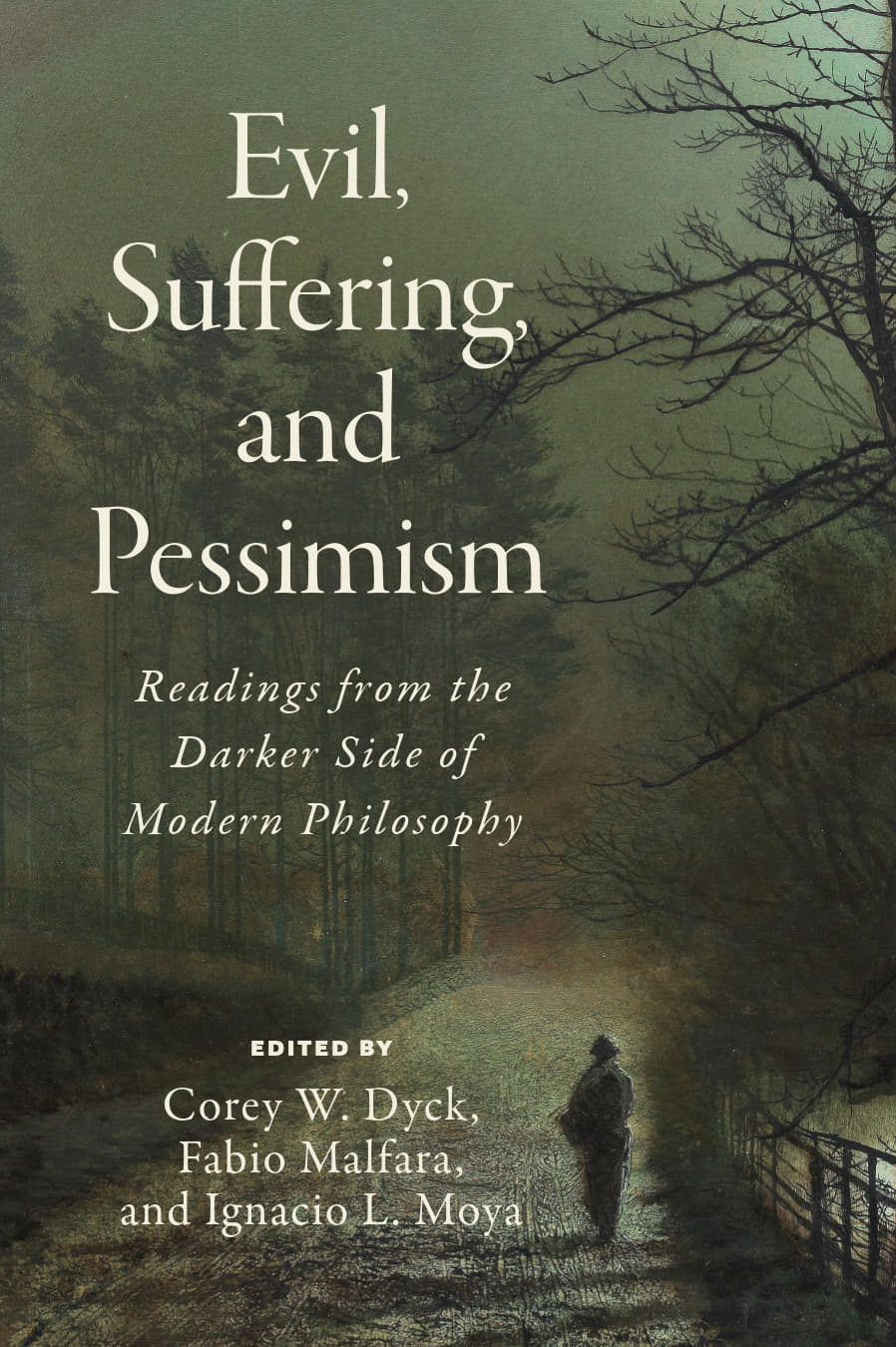
Evil, Suffering, and Pessimism
Readings from the Darker Side of Modern Philosophy
  • Publication Date: February 28, 2026
  • ISBN: 9781554816675 / 155481667X
  • 330 pages; 6" x 9"

Price for your region

Note on pricing.

Request Exam Copy

Examination copy policy

Availability: Worldwide

Evil, Suffering, and Pessimism

Readings from the Darker Side of Modern Philosophy

  • Publication Date: February 28, 2026
  • ISBN: 9781554816675 / 155481667X
  • 330 pages; 6" x 9"

Is it possible to explain the existence of evil under the supposition of a supremely good creator? Are we ourselves the cause of most of the suffering that befalls us? Is life generally more painful than it is pleasant, and if so is non-existence preferable to existence? Is happiness ever even attainable? These questions occupied some of the best-known philosophers of the 17th to 19th centuries—figures such as G. W. Leibniz, Pierre Bayle, David Hume, Jean-Jacques Rousseau, Voltaire, Immanuel Kant, Arthur Schopenhauer, and Friedrich Nietzsche. These questions were also richly discussed by writers often since excluded from the philosophical canon, such as Ottobah Cugoano, Mary Astell, and Olga Plumacher. For these thinkers, philosophy was not only a fair-weather friend; it was also a companion in storms and in darkness—it was a way of thinking about, thinking through, and contending with the profoundly unsettling. In this unique and provocative anthology, one will find philosophers bending their intellectual efforts to the darker side of life.

Preface

Unit I: The Case against God—Theodicy and the Problem of Evil

    • Chapter 1: Bayle on the Insoluble Problem of Evil
      • Pierre Bayle, The Historical and Critical Dictionary, from “Manicheans”
      • Pierre Bayle, The Historical and Critical Dictionary, from “Paulicians”
    • Chapter 2: Philosophical Optimism—Leibniz and Pope
      • Alexander Pope, from “An Essay on Man”
      • Gottfried Wilhelm Leibniz, from Theodicy: Essays on the Goodness of God, the Freedom of Man, and the Origin of Evil
    • Chapter 3: Atrocious Evil—Voltaire, Rousseau, and Cugoano
      • Voltaire, “On the Lisbon Disaster”
      • Jean-Jacques Rousseau, from “A Letter from M. Rousseau to M. de Voltaire”
      • Ottobah Cugoano, from Thoughts and Sentiments on the Evil and Wicked Traffic of the Slavery and Commerce of the Human Species
    • Chapter 4: Hume and Kant on the Impossibility of Theodicy
      • David Hume, Dialogues concerning Natural Religion, Part XI
      • Immanuel Kant, from “On the Failure of all Philosophical Attempts at Theodicy”

Unit II: Evil without Sin—Understanding Suffering

    • Chapter 5: Bayle and Hume on Physical Evil
      • Pierre Bayle, The Historical and Critical Dictionary, from “Xenophanes”
      • David Hume, Dialogues concerning Natural Religion, from Part X
    • Chapter 6: Sources of Suffering—Rousseau and Astell
      • Jean-Jacques Rousseau, from Discourse on the Origin and the Foundation of the Inequality of Mankind
      • Mary Astell, from Some Reflections upon Marriage

Unit III: The Worst of All Possible Worlds—The Challenge of Pessimism

    • Chapter 7: Schopenhauer on the Case for Pessimism
      • Arthur Schopenhauer, from The World as Will and Representation, Volume I
      • Arthur Schopenhauer, from The World as Will and Representation, Volume II
    • Chapter 8: Defending Pessimism—Von Hartmann and Plumacher
      • Eduard von Hartmann, from The Philosophy of the Unconscious
      • Olga Plumacher, from “Pessimism”
    • Chapter 9: Schopenhauer and Nietzsche on Redemption through Art
      • Arthur Schopenhauer, from The World as Will and Representation, Volume I
      • Friedrich Nietzsche, from The Birth of Tragedy
    • Chapter 10: The Negation and Affirmation of Life—Schopenhauer and Nietzsche
      • Arthur Schopenhauer, from The World as Will and Representation, Volume I
      • Friedrich Nietzsche, from The Genealogy of Morals, Essay III
      • Friedrich Nietzsche, The Birth of Tragedy, from “An Attempt at Self-Criticism”
      • Friedrich Nietzsche, from The Joyful Wisdom

Corey W. Dyck is Professor and Chair of the Philosophy department at the University of Western Ontario, and author of several books on early modern philosophy including Wolff and the First Fifty Years of German Metaphysics (Oxford UP, 2024) and Early Modern German Philosophy (1690-1750) (Oxford UP, 2019).

Fabio Malfara is a doctoral student at the University of Western Ontario.

Ignacio Moya is Instructor at Conestoga College.

  • • Approaches modern philosophy from a distinctive, engaging perspective
  • • Over 20 readings, dating from the 17th to 19th centuries
  • • Selections are arranged in themed chapters, each of which includes a brief contextualizing introduction
  • • Includes works from members of historically underrepresented groups, integrated seamlessly into the broader historical narrative
  • • Readings include examples of non-standard forms of philosophical expression—poetry, fiction, aphorisms—in addition to traditional essays and treatises
  • • Includes several less-familiar but nonetheless fascinating works from canonical authors such as Hume, Rousseau, and Kant