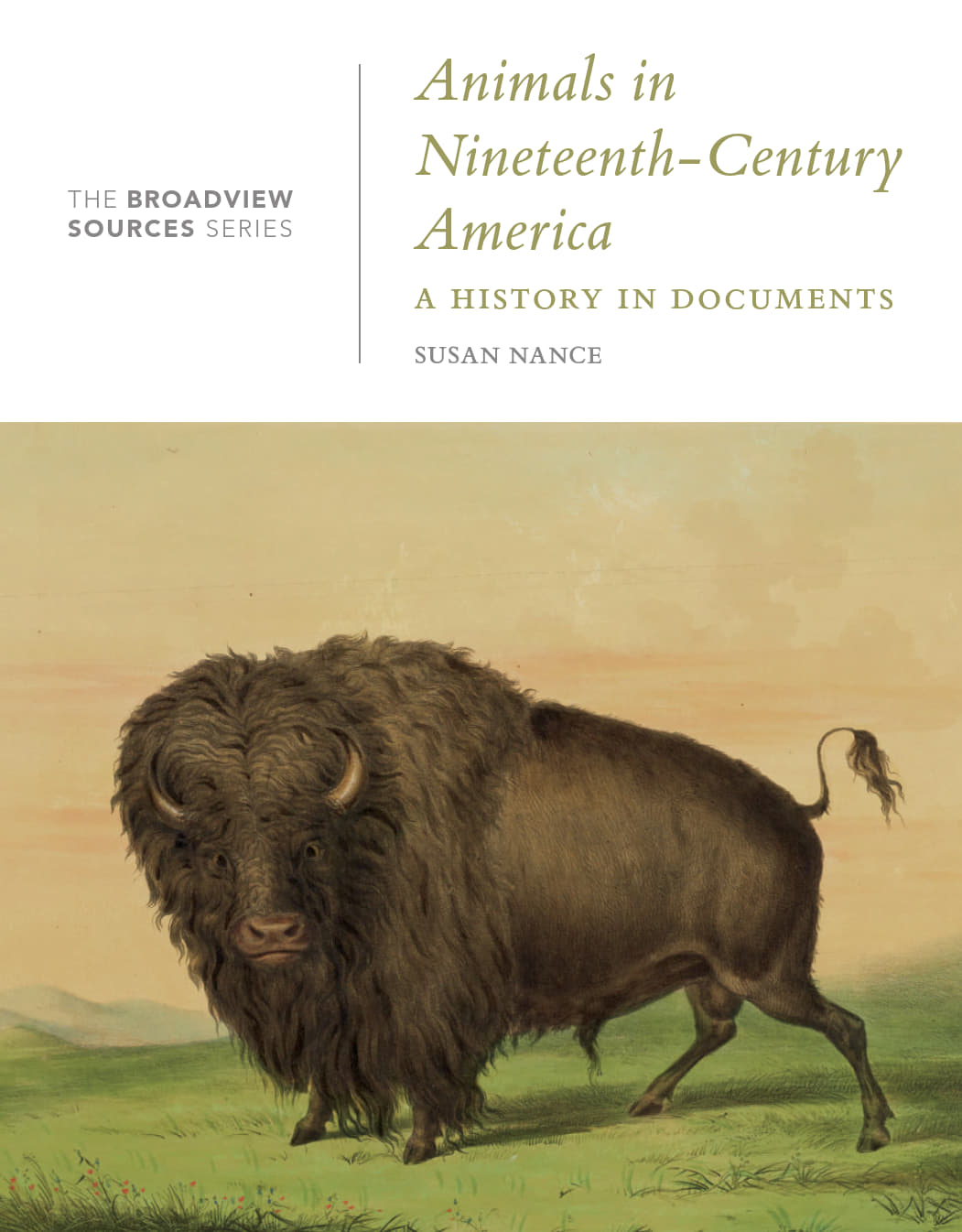
Animals in Nineteenth-Century America examines animal life and human-animal relationships in a pivotal century in American and world history. Spanning the “long nineteenth century” (1770s–1910s), this collection of primary sources and images traces how the United States was transformed in this period from a mosaic of Indigenous multispecies homelands into a managed landscape of industry, settlement, and control.
Each source is accompanied by a detailed contextual headnote and helpful annotations, and Susan Nance’s introductory essay charts the arc of animal history as various species confronted anthropogenic environmental change and human politics. The volume will be a valuable resource for those studying animal history, environmental history, or American history.
Comments
“A trove of fascinating, often unexpected, and consistently important documents that demonstrate the complexities of human-animal relations in nineteenth-century America. Nance’s expert introductions, annotations, and questions/writing prompts guide readers to a nuanced understanding of the documents and their relation to broader historical contexts. Exploring this book will be a thought-provoking experience for anyone.” — Nigel Rothfels, University of Wisconsin–Milwaukee
“Susan Nance has created an extraordinary resource for scholars and students of animal history and nineteenth-century America. This collection of primary sources offers rare breadth and depth on a century of remarkable change, highlighting a diverse set of human and nonhuman actors who interacted and shaped the past.” — Andrew Robichaud, Boston University
“Susan Nance brings us a much-needed collection of diverse and textured sources and documents that is destined to become a classic text in American animal history. Animals in Nineteenth-Century America will be priceless in the classroom. And it sets a high bar for the larger field of global historical studies.” — Daniel Vandersommers, University of Dayton
Introduction
Chronology
PART 1: COLONIZATION AND THE NEW ZOOPOLITICS
TOPIC 1: TWO WORLDVIEWS—RELATIONALITY AND COLONIZATION
- 1. Bill Reid (Haida) tells the Raven creation story in word and sculpture: The Raven and the First Men (1984; 1980)
- 2. Thomas Jefferson rebuts European accusations that North American animals are “degenerate”: Jefferson, Notes on the State of Virginia (1787)
TOPIC 2: DEER AS “GAME” IN THEIR ENVIRONMENT
- 3. An Irish writer describes settler relations with deer and other wildlife after the destruction of the bison in frontier areas of Pennsylvania and Kentucky: Thomas Ashe, Travels in America, Performed in the Year 1806 (1809)
- 4. Meriwether Lewis documents deer and other animals seen and hunted near the Rocky Mountains: Journals of the Lewis and Clark Expedition, 1804–1806 (1904)
- 5. A Philadelphia schoolbook explains deer to children: “Lesson XCII: Of the Deer,” in Lessons for Youth (1801)
- 6. New Jersey endeavors to manage the competing interests of deer, hunters, and landowners: An Act for the Preservation of Deer, and Other Game, and to Prevent Trespassing with Guns (ca. 1846)
TOPIC 3: LIVESTOCK AND THE GRAPHIC REVOLUTION
- 7. American Turf Register and Sporting Magazine celebrates elite horse breeders and a famous thoroughbred: “Memoir of the Winter Arabian” (1830)
- 8. A patent medicine trade card portrays livestock and the agricultural myth: “Thompson’s Vegetable Cattle Powder for Diseases of Horses, Cattle, Hogs & Sheep” (1868)
- 9. A popular children’s magazine instructs young readers about “vermin”: “Deadly Attack of a Wolf on a Man,” Frank Leslie’s Boy’s & Girl’s Weekly (1867)
- 10. A prominent cartoonist exposes the willfulness of horses at the track: “Getting a Hoist” (1875) and “‘A Balk’ on a Sweepstake” (1881)
TOPIC 4: RACIALIZATION AND ANIMALIZATION
- 11. Paperwork listing enslaved persons, livestock, and other property of a Virginia family: “Record of Taxes on Property, including enslaved persons, owned by John Rouzee” (1835)
- 12. Frederick Douglass explains the dehumanizing politics of horses and plantation resources: Narrative of the Life of Frederick Douglass, an American Slave (1845)
- 13. A formerly enslaved man recalls how he viewed and interacted with animals as a boy: WPA Oklahoma Slave Narratives (1850s)
- 14. A political cartoon questions the aspirations of freedmen: “Cutting His Old Associates” (1863)
- Questions to Consider/Writing Prompts
PART 2: DISCOVERING EXTINCTION
TOPIC 5: TAKING THE MEASURE OF BIRDS
- 15. John James Audubon describes the character and behaviors of the bald eagle: “The White-Headed or Bald Eagle,” The Birds of America (1840)
- 16. A Potawatomi leader explains his experiences of passenger pigeons: Chief Pokagon, “Wild Pigeon of North America,” The Chautauquan (1895)
- 17. A market hunter explains his view of the passenger pigeon trade: E.T. Martin, “The Pigeon Butcher’s Defense,” American Field (January 25, 1879)
- 18. An anti-cruelty activist alerts women to their complicity in the decline of bird populations: L.J. Vance, “Birds or Bonnets—Which?,” Our Animal Friends (1893)
TOPIC 6: UNSETTLED ECOLOGIES
- 19. An ethnographer reports on Blackfoot accounts of hunting bison with the buffalo horse in the mid-nineteenth century: John C. Ewers, The Horse in Blackfoot Indian Culture (1955)
- 20. A reporter from Chicago explains how Montanans remember the bison: “The Last Buffalo,” Thomas County Cat (1888), and a Michigan photographer documents buffalo skulls at the Rougeville Glueworks (1892)
TOPIC 7: THINKING WITH TAXIDERMY
- 21. William Temple Hornaday explains the art and science of preserved animal bodies: Taxidermy and Zoological Collecting; A Complete Handbook for the Amateur Taxidermist, Collector, Osteologist, Museum-Builder, Sportsman, and Traveller (1894)
- 22. Henry Ward and P.T. Barnum discuss the work of preserving the skeleton and skin of Jumbo the elephant for the Barnum & Bailey Circus: Ward-Barnum correspondence (1885)
TOPIC 8: CAPTIVITY, EDUCATION, AND ENTERTAINMENT
- 23. Proprietors of the Zoological Institute illustrate the variety of animals in their traveling show: “The Association’s Celebrated and Extensive Menagerie and Aviary …” (1835)
- 24. A children’s book authorized by showman P.T. Barnum imaginatively portrays live animal acts and other elements in his circus: Barnum’s Great Show (1888)
- 25. Picture postcards celebrate the zoological garden as an icon of the modern city: Philadelphia Zoological Garden postcards (ca. 1898–1912)
- Questions to Consider/Writing Prompts
PART 3: ANIMALS, CITIES, AND INDUSTRIALIZATION
TOPIC 9: URBAN ANIMALS AND THEIR WELFARE IN NEW YORK
- 26. English visitors describe the pigs of Cincinnati and Manhattan: Frances Trollope, Domestic Manners of the Americans (1832), and Charles Dickens, American Notes for General Circulation (1842)
- 27. A popular periodical exposes the distillery dairy scandal: “The Swill Milk Trade of New York and Brooklyn,” Frank Leslie’s Illustrated Magazine (1858)
- 28. A handbill advertises pesticide: Rat dynamite, or dynamite for rats, mice, weasels, woodchucks, skunks, musk rats, roaches, bed bugs, water bugs, potato bugs, flies, ants, insects, vermin, etc., etc. (1850)
TOPIC 10: MOSQUITOES AND HUMAN WELFARE IN NEW YORK
- 29. A cartoon depicts mosquito behavior indoors: The Mosquito War (1854)
- 30. A songbook satirizes mosquito behavior: “The Mosquito: A Song” (1889) 137
- 31. Scientists and public health officials discuss the twin challenge of mosquitoes and people: American Mosquito Extermination Society, Year Book for 1904–1905, Containing the Proceedings of the Second Anti-Mosquito Convention (1906)
TOPIC 11: ANTI-CRUELTY ACTION AND THE ETHIC OF KINDNESS
- 32. P.T. Barnum and Henry Bergh debate the needs of captive snakes and rodents fed to them at Barnum’s American Museum (1866–67)
- 33. A concerned citizen writes a letter to the editor about animal abuse: “Cruelty to Animals—Cases in Point,” The Brooklyn Union (1867)
- 34. Boston animal advocates give advice on euthanizing dogs, cats, and horses: Frontmatter to an American Humane Association edition of Anna Sewell’s Black Beauty, His Grooms and Companions (1890)
TOPIC 12: EQUINES AND ENERGY
- 35. A farmer’s catalogue advertises workhorse whims: “Seeds and Implements No. 2 Buckeye Horse-Power” (1902)
- 36. A popular horse manual advises how to have a “happy horse”: Biggle Horse Book: A Concise and Practical Treatise on the Horse (1895)
- 37. A Pennsylvania newspaper reports on mule labor in the coal industry: “Mine Mule’s Burden,” Wilkes-Barre Record (1905)
- Questions to Consider/Writing Prompts
PART 4: ANIMALS, CONSUMERS, AND CONTRADICTIONS
TOPIC 13: INVESTIGATING NONHUMAN INTELLIGENCE
- 38. A popular manual advises children on nonhuman cognition and learning: Haney’s Art of Training Animals: A Practical Guide for Amateur or Professional Trainers (1869)
- 39. A show program presents a famous “educated” horse: Beautiful Jim Key (ca. 1900)
- 40. A reporter describes the Beautiful Jim Key show at the St. Louis World’s Fair: Thomas Addison, “On the ‘Pike’: What the Man from the State of Kansas Saw,” Bedford Gazette (1904)
TOPIC 14: VIVISECTION AND THE PUBLIC INTEREST
- 41. A prominent surgeon lauds the utility of animal experimentation: William W. Keen, Our Recent Debts to Vivisection: The Address to the Graduates at the Thirty-Third Commencement of the Woman’s Medical College of Pennsylvania (1885)
- 42. An animal welfare activist responds: Caroline Earle White, An Answer to Dr. Keen’s Address Entitled “Our Recent Debts to Vivisection” (1886)
- 43. A political cartoon explores the contradictions of anti-vivisection sentiment in a consumer society: “Vivisection. The Critics and the Criticized,” Puck (1914)
TOPIC 15: INDUSTRIALIZING MEAT
- 44. A journalist documents the sourcing of seafood: Marcel Edant, “The French Cod Fisheries on the Newfoundland Banks,” Harper’s Weekly (1891)
- 45. Muckraking journalist Upton Sinclair exposes mechanized livestock slaughter in Chicago: The Jungle (1906)
TOPIC 16: DOGS, FAME, AND CELEBRITY
- 46. Trade cards celebrate famous bloodhounds of the US Civil War: “Hero” and “Spot” (1869)
- 47. A Connecticut newspaper reprints a Chicago Tribune story about Jack: “The White House Dog,” Waterbury Evening Democrat (1901)
TOPIC 17: PET KEEPING AND CONSUMER CULTURE
- 48. Teddy Roosevelt remembers his children’s wild pets: Theodore Roosevelt: An Autobiography (1914)
- 49. A middle-class woman in Brooklyn discusses her pets and animal ethics: Ruth M. Johnstone, At My Window; Hours with My Pigeons (1911)
- 50. Photographers document the popularity of the teddy bear: Image series (1902–20)
- Questions to Consider/Writing Prompts
Select Bibliography
Susan Nance is Professor of History at the University of Guelph. She is the author of Rodeo: An Animal History and Entertaining Elephants: Animal Agency and the Business of the American Circus.