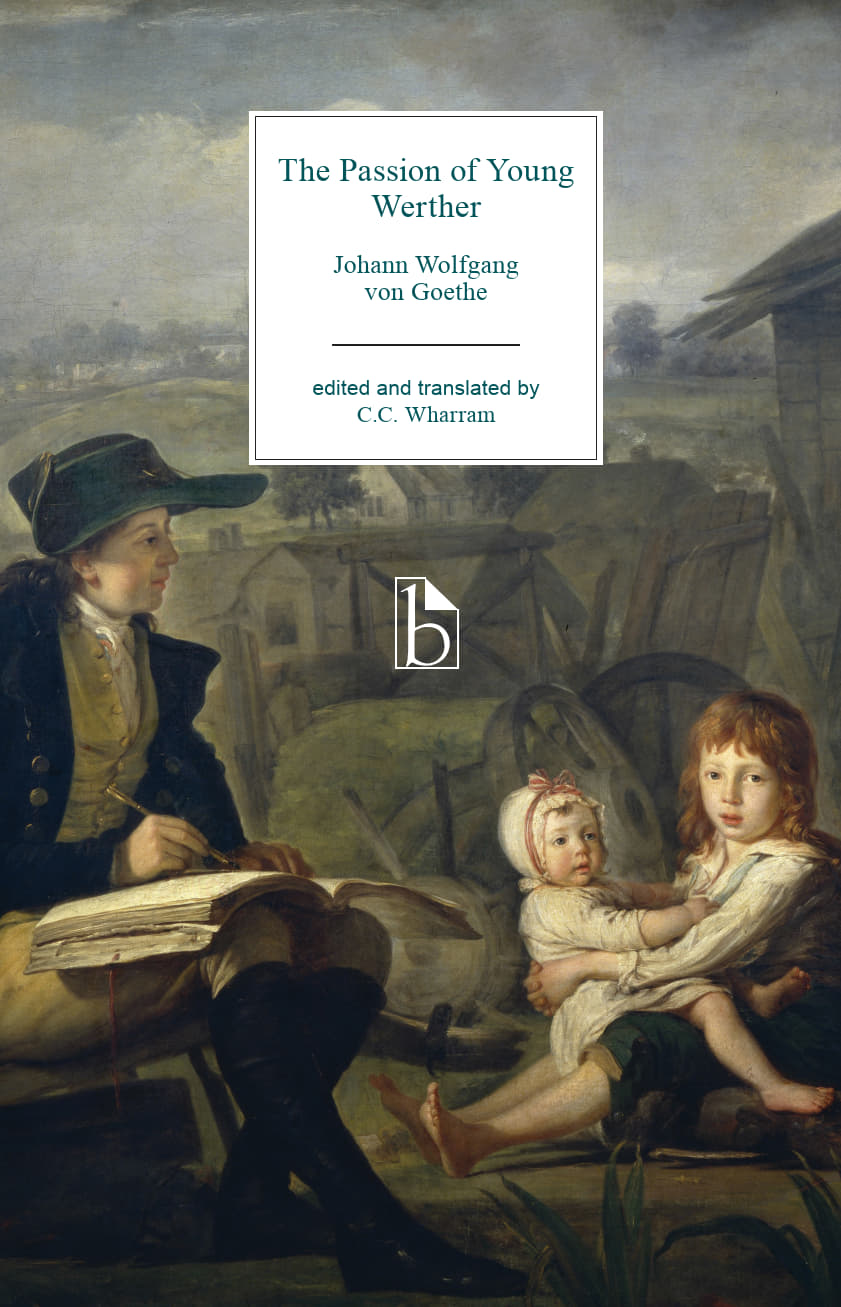
First published in 1774, The Passion of Young Werther was a phenomenon, and had a profound influence on literature and culture on both sides of the Atlantic—and eventually around the globe. Werther himself became synonymous with sensibility and sensitivity, and the novel’s depiction of youthful passion generated heated debates about its effects in the context of 18th-century “Werthermania.” C.C. Wharram’s new translation provides modern readers with a faithful but contemporary version of the text that emphasizes the original’s musicality and intensity.
Because Werther resonated so strongly in both the British and American publishing worlds, this Broadview edition appends many late-eighteenth-century primary sources taken from books, journals, and newspapers in order to demonstrate the generative effects of Goethe’s novel. The introduction and historical appendices also address the debates around Werther, especially in relation to the depiction of suicide.
Comments
“Werther has enjoyed and endured many translations. But this is the most user-friendly translation of Goethe’s novel ever published in English, in part because C.C. Wharram makes the novel’s translatability a question to explore rather than a problem to solve. Students and scholars alike will benefit from Wharram’s illuminating explanatory notes and suggestive framing materials. His typographical emendations bring out the contrast between the protagonist’s impassioned epistolary voice and the sympathetic—if ironic—fictional editor who frames the story and brings it to its strangely anticlimactic conclusion. Scrupulously attentive to the nuances of Goethe’s language, yet unapologetically orienting the text’s idioms towards contemporary readers, Wharram helps us see how the novel’s worries remain our own.” — David L. Clark, McMaster University
“C.C. Wharram’s edition of Johann Wolfgang von Goethe’s most famous novel is an important contribution to scholarship. This thoughtful translation of the text challenges the reader to view it in a fresh way from the very title page, where the familiar ‘sorrows’ in the title is replaced with ‘passion.’ Wharram’s engaging introduction and generous selection of appendices situate the text in the cultural context of the literature of sensibility and early Romanticism, when it was a popular phenomenon across Europe. The Passion of Young Werther is a joy to read.” — Michelle Faubert, University of Manitoba
Acknowledgements
Introduction
Johann Wolfgang von Goethe: A Brief Chronology
A Note on the Text
The Passion of Young Werther
Appendix A: Source material
- 1. David Hume, A Treatise of Human Nature, 1740
- 2. Adam Smith, Theory of Moral Sentiments, 1759
- 3. Friedrich Gottlieb Klopstock, “The Rite of Spring,” 1759/1771
- 4. James Macpherson, “Berrathon” and “Songs of Selma,” The Works of Ossian, 1762
Appendix B: Prefaces to Translations and Reviews
- 1. “Preface” to The Sorrows of Werter: A German Story, 1779
- 2. Review in The London Magazine, May 1779
- 3. Review in The Critical Review of The Sorrows of Werther, June 1779
- 4. Review in The Westminster Magazine, July 1779
- 5. Review in The London Review of English and Foreign Literature, July 1779
- 6. Review in The Town and Country Magazine, August 1779
- 7. “Preface” and “Notes/Afterward” to Werter and Charlotte, a German story, 1786
- 8. William Render, “Advertisement of the Translator” for The Sorrows of Werter, 1801
- 9. Guo Moruo, “Preface to The Sorrows of Werther,” 1922
Appendix C: Poems and Songs about Werther
- 1. Charlotte Smith, sonnets “Supposed to be written by Werter,” 1784, 1786
- 2. Anna Seward, “Advice to Mrs. Smith. A Sonnet,” 1786
- 3. Song: “The Sorrows of Charlotte at the Tomb of Werter,” The Gentleman’s Magazine, 1785
- 4. “To the Editors of The European Magazine,” The European Magazine, 1785
- 5. Song: “Sorrows of Werter,” Sung by Mrs. Kennedy, Universal Magazine, June 1785
- 6. Dr. Joseph B. Ladd, “Charlotte’s Soliloquy—To the Manes of Werter,” American Museum, February 1787
- 7. Anne Francis, “The Ghost of Charlotte at the Tomb of Werter,” 1790
- 8. William Makepeace Thackeray, [Satirical Poem] “Werther had a love for Charlotte,” 1853
Appendix D: “Reading Werter,” Excerpts from Novels, Sermons, and Poems
- 1. Herbert Croft, Love and Madness, 1780
- 2. Charles Dodd, The Curse of Sentiment, 1787; Review in The General Magazine, Oct. 1787
- 3. Benjamin Rush, Thoughts upon Female Education, 1787
- 4. William Hill Brown, The Power of Sympathy (the “first” American novel), 1789
- 5. Charlotte Smith, Emmeline, The Orphan of the Castle, 1788
- 6. A Lady, “Answer to a Person Expressing Surprise at the Author’s not Shedding Tears,” The Literary Magazine and British Review, January 1791
- 7. Anna Seward, “Written in the Blank Page of the Sorrows of Werter,” 1785/6, published 1810
- 8. Mary Shelley, Frankenstein, 1818
Appendix E: Werther and the Problem of Suicide
- 1. David Hume, “On Suicide,” 1771
- 2. “A Remarkable Act of Suicide” from The Westminster Magazine, November 1783
- 3. “Deaths,” The Gentleman’s Magazine, November 1784
- 4. The Gentleman’s Magazine, “Letter” in response to above death notice, December 1784
- 5. M. Hays, “Observations on the Sorrows of Werter,” Universal magazine of knowledge and pleasure, December 1784
- 6. Charles Moore, A full inquiry into the subject of suicide, 1790
Works Cited and Recommended Reading
C.C. Wharram is Director of the Institute for the Humanities at Eastern Illinois University.