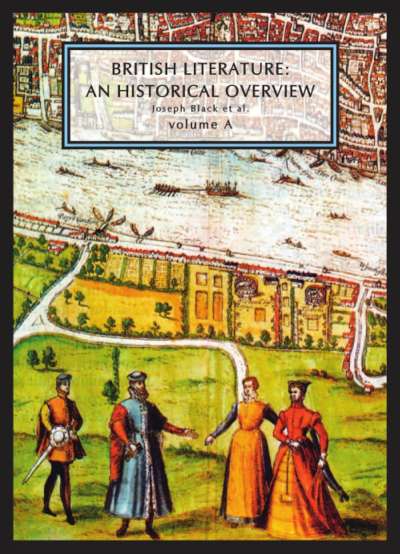
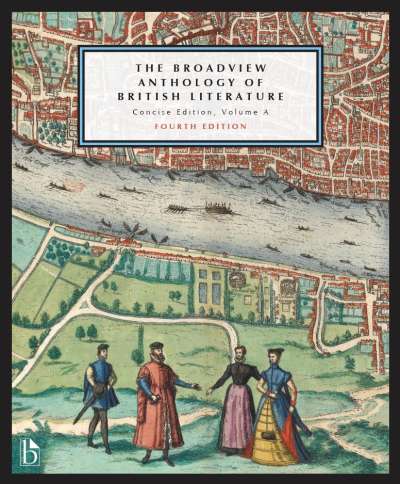
Guided by the latest scholarship, The Broadview Anthology of British Literature is acclaimed for its inclusiveness and its deep attention to literature’s historical and cultural contexts. The Broadview is structured to meet the needs of today’s students, with an unparalleled selection of illustrations and contextual materials, accessible and engaging introductions, and full explanatory annotations.
The full anthology comprises six bound volumes, together with a substantial website component, greatly expanding the range of texts that are available to teach. Many longer works are also available from the publisher in separate volumes that may at the instructor’s request be bundled together with this anthology.
Learn more about The Broadview Anthology of British Literature on this page.
Comments
Comments on The Broadview Anthology of Literature:
“ … sets a new standard by which all other anthologies of British literature will now have to be measured.” — Graham Hammill, University at Buffalo, The State University of New York
“ …After twenty years of teaching British literature from the Norton anthologies, I’m ready to switch to the Broadview. The introductions to each period are key to teaching a survey course, and those in the Broadview seem to me to be both more accessible to students and more detailed in their portraits of each era than are those of the Norton. And Broadview’s selection of authors and texts includes everything I like to teach from the Norton, plus a good deal else that’s of real interest.” — Neil R. Davison, Oregon State University
“Norton’s intros are good; Broadview’s are better. … If you have not considered the anthology for your courses, I recommend that you do so.” — Robert J. Schmidt, Tarrant County College
“ …I have been using The Broadview Anthology of British Literature for three years now. I love it—and so do my students!” — Martha Stoddard-Holmes, California State University, San Marcos
Readings highlighted in gray are included on the anthology’s companion website.
Preface
Acknowledgments
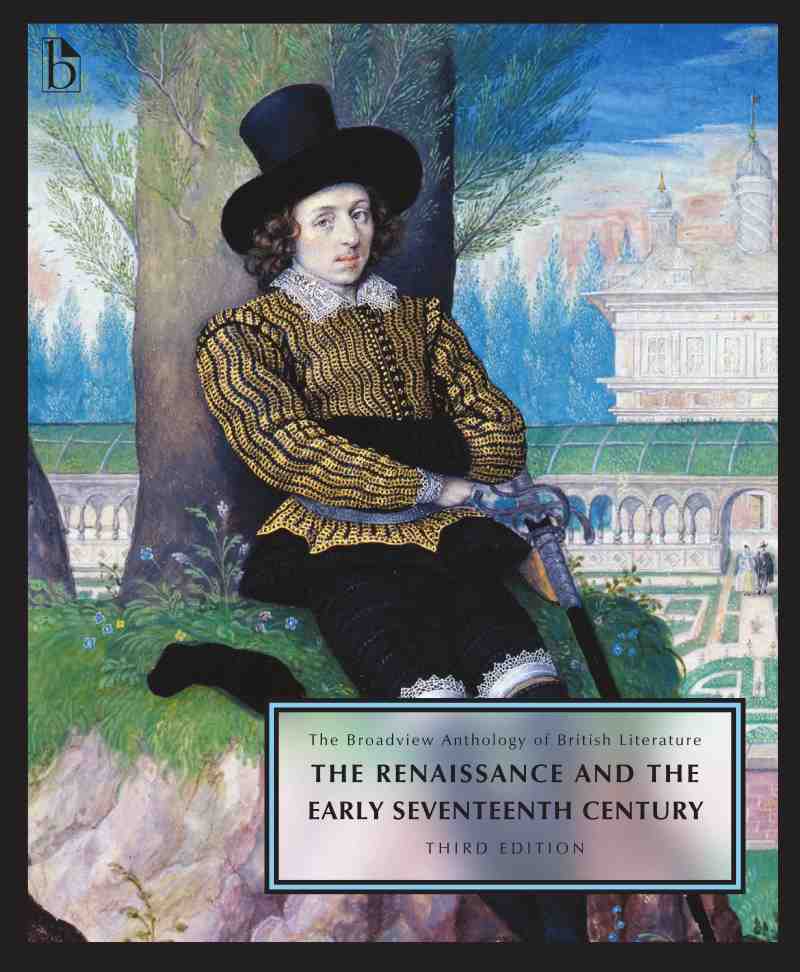
THE RENAISSANCE AND THE EARLY SEVENTEENTH CENTURY
INTRODUCTION TO THE RENAISSANCE AND THE EARLY SEVENTEENTH CENTURY
- Humanism
Scientific Inquiry
The Reformation in England
Wales, Scotland, Ireland
Edward VI, Mary I, and Elizabeth I
Elizabeth I and Gender
Homoeroticism and Cross-Dressing
Economy and Society in the Sixteenth and Seventeenth Centuries
“The Round Earth’s Imagined Corners”
The Stuarts and the Civil Wars
Literary Genres
Literature in Prose and the Development of Print Culture
Poetry
The Drama
The English Language in the Sixteenth and Seventeenth Centuries
HISTORY OF THE LANGUAGE AND OF PRINT CULTURE
JOHN SKELTON
- The Tunning of Elinour Rumming
To Mistress Isabell Pennell
To Mistress Margaret Hussey
Philip Sparrow
SIR THOMAS MORE
- Utopia: The Best State of a Commonwealth and the New Island of Utopia
- Thomas More to Peter Giles
Book 1
Book 2
-
Chapter 1
Chapter 2: The Cities, and Especially Amaurote
Chapter 2: The Cities, and Especially Amaurote
Chapter 3: The System of Local Government
Chapter 4: Crafts and Occupations
Chapter 5: Their Dealings With One Another
Chapter 6: Traveling
Chapter 7: Slavery
Chapter 8: Warfare
Chapter 9: The Religions in Utopia
- IN CONTEXT: Illustration of Utopia
IN CONTEXT: Utopian Language
IN CONTEXT: Poems in the Utopian Tongue
- from A Dialogue of Comfort Against Tribulation
- Part 2, Chapter 14
Part 2, Chapter 16
Part 3, Chapter 10
Response to Luther
- The “Tower Correspondence”
- To Margaret Roper (April/May 1534)
To Margaret Roper (May 1534)
To Margaret Roper (2 or 3 May 1535)
To Margaret Roper (3 June 1535)
To Margaret Roper (5 July 1535)
- IN CONTEXT: Thomas More
- Erasmus’s Description of More
Roper’s Description of More’s Death
WILLIAM TYNDALE
- Tyndale’s English Bible, King James Bible, Geneva Bible, Douay-Rheims Bible
- Genesis: Chapter 1
Matthew: Chapter 5
CONTEXTS: RELIGION AND DEVOTIONAL LIFE
- The Martyrdom of Anne Askew
- from Anne Askew, “The First Examination of Anne Askew”
from John Foxe, Acts and Monuments of These Latter and Perilous Days
Anonymous, “I Am a Woman Poor and Blind”
- from Thomas Cranmer, The Book of Common Prayer
- The Solemnization of Matrimony
The Order for the Burial of the Dead
- John Foxe
- from John Foxe, Acts and Monuments of These Latter and Perilous Days
- The Benefit and Invention of Printing
Bishop Ridley and Bishop Latimer
- from Lady Margaret Hoby, Diaries
from Owen Felltham, Resolves
Jews and Christians
- from Richard Morison, A Remedy for Sedition
from Samuel Usque, Consolation for the Tribulations of Israel
from Christopher Marlowe, The Jew of Malta
- from Thomas Lodge, Wit’s Misery, and the World’s Madness
from Edward Coke, The Institutes of the Laws of England, Part 2
SIR THOMAS WYATT
- Sonnets
- 10 (“The long love that in my thought doth harbour”)
29 (“The pillar perished is whereto I leant”)
31 (“Farewell, Love, and all thy laws forever”)
- Epigrams
- 38 (“Alas, madam, for stealing of a kiss”)
48 (“Vulcan begat me; Minerva me taught”)
60 (“Tagus, farewell, that westward with thy streams”)
- Ballads
- 80 (“They flee from me that sometime did me seek”)
94 (“Blame not my lute, for he must sound”)
- Songs
- 109 (“My lute, awake! Perform the last”)
123 (“Who list his wealth and ease retain”)
- Epistolary Satires
- 149 (“Mine own John Poyns, since ye delight to know”)
- IN CONTEXT: Epistolary Advice
JOHN FOXE
- from John Foxe, Acts and Monuments of These Latter and Perilous Days
HENRY HOWARD, EARL OF SURREY
- Love, that Doth Reign and Live within My Thought
Set Me Whereas the Sun Doth Parch the Green
Alas! So All Things Now Do Hold Their Peace
So Cruel Prison How Could Betide
Wyatt Resteth Here
from Certain Books of Virgil’s Aeneis: Book 2
THE ELIZABETHAN SONNET AND LYRIC
- The Continental Background
- Francesco Petrarch
- from Rime Sparse
- 134 (“Pace non trovo et non ò da far guerra”)
134 (“I find no peace and all my war is done”)
140 (“Amor, che nel penser mio vive et regna”)
140 (“Love, that doth reign and live within my thought”)
189 (“Passa la nave mia colma d’oblio”)
189 (“My galley chargèd with forgetfulness”)
190 (“Una candida cerva sopra l’erba”)
190 (“Whoso list to hunt, I know where is a hind”)
- Gaspara Stampa
- 132 (“Quando io dimando nel mio pianto Amore”)
132 (“When in my weeping I inquire of Love”)
- Joachim Du Bellay
- from L’Olive augmentée
- 113 (“Si nostre vie est moins qu’une journée”)
113 (“If this, our life, be less than but a day”)
- from Les Regrets
- 31 (“Heureux qui, comme Ulysse, a fait un beau voyage”)
31 (“Blest he who like Ulysses voyaged fair and wide”)
- Pierre de Ronsard
- (“Je vouldroy bien richement jaunissant”)
(“I would in rich and golden coloured rain”)
(“Quand vous serez bien vielle, au soir à la chandelle”)
(“When you are very old, by candle’s flame”)
- Anne Lock
- from A Meditation of a Penitent Sinner
- (“Long have I heard, and yet I hear the sounds”)
(“Look on me, Lord: though trembling I beknowe”)
- Henry Lock
- Sonnet 21 (The Merchant and the Pearl)
“To the Honorable Lady, the Lady Rich”
- Samuel Daniel
- from Delia
- 6 (“Fair is my love, and cruel as she’s fair”)
28 (“Raising my hopes on hills of high desire”)
33 (“When men shall find thy flower, thy glory pass”)
- Michael Drayton
- from Idea
- 6 (“How many paltry, foolish, painted things”)
61 (“Since there’s no help, come let us kiss and part”)
63 (“Truce, gentle Love, a parley now I crave”)
- William Shakespeare
- from Romeo and Juliet (Act 1, Scene 5)
- Sir John Davies
- from Gulling Sonnets
- 3 (“What eagle can behold her sun-bright eye”)
- John Davies of Hereford
- from The Scourge of Villany
- (“If there were, oh! an Hellespont of cream”)
- Richard Barnfield
- from Cynthia
- 14 (“Here, hold this glove [this milk-white cheverel glove]”)
17 (“Cherry-lipped Adonis in his snowy shape”)
- George Gascoigne
- Anonymous
- Ode (“Absence, hear thou my protestation”)
ANNE LOCK
- A Meditation of a Penitent Sinner [complete]
LITERATURE IN IRELAND, GAELIC SCOTLAND, AND WALES
- Ireland and Gaelic Scotland
- Gofraidh Fionn Ó Dálaigh
- Isabel, Countess of Argyll
- There’s a Young Man in Pursuit of Me / Atá Fleasgach Ar Mo Thí
Woe to the One Whose Sickness Is Love / Is Mairg Dá Ngalar An Grádh
- Anonymous
- Lament for MacGregor of Glenstrae, who was beheaded in 1570
- Tadhg Dall Ó hUiginn
- from “The Battle of Drumleene”
Enniskillen
A Satire
- Geoffrey Keating
- O Woman Full of Wiles
Bear with Thee, O Letter, My Blessing
On the Miseries of Ireland
from History of Ireland
- Dáibhí Ó Bruadair
- Gone Are All the Noble Poets
After the Death of the Poets
- Geoffrey O’Donoghue of the Glens
- This caps all their tricks, this statute from overseas
- IN CONTEXT: English Invasions of Ireland
- from Edmund Spenser, A View of The Present State of Ireland
from Oliver Cromwell, Letter to the English Parliament (17 September 1649)
from Father Thomas Quinn, Letter to the Vatican (28 August 1656)
- Wales
- Dafydd ap Gwilym
- The Skylark
The Gull
Trouble at an Inn
Morfudd Like the Sun
The Mirror
The Ruin
The Poet and the Grey Friar
- Tudur Penyllyn
- Conversation between a Welshman and an Englishwoman / Ymddiddan Rhwyng Cymro a Saesnes
- Gwerful Mechain
- To the Vagina
To Her Husband, for Beating Her
White Flour, Earthflesh, Cold Fleece
Christ’s Suffering
- Elis Gruffydd
- from Chronicle
- The Story of Gwion Bach, Who Became Taliesin
Llywelyn and the Fool
- Siôn Cent
- from The Illusion of the World / Hud a Lliw y Byd
THE CORNISH Ordinalia
- Noah and the Ark
- Origo Mundi, lines 917–1258
- The Crucifixion
- Passio Christi, lines 2504–3030
- The Death of Pilate
- Ressurexio Domini, lines 1587–2044
BALDASSARE CASTIGLIONE/THOMAS HOBY
- from The Courtier
- from Book 1
from Book 1 [additional material]
from Book 3
from Book 4
from Book 4 [additional material]
LADY JANE GREY
- Letters
- Lady Jane Grey to Her Father, 9 February 1554
A Letter Written by the Lady Jane to Her Sister Lady Katherine
- A Certain Prayer of the Lady Jane in the Time of Her Trouble
Certain Pretty Verses Written by the Said Lady Jane with a Pin
IN CONTEXT: Lady Jane Grey
- from John Foxe, Acts and Monuments of These Latter and Perilous Days
THOMAS DELONEY
EDMUND SPENSER
- from The Faerie Queene
- Book 1
from Book 2
- from Book 3
- Canto 6
Canto 11
Canto 12
- from Book 5
- Letter to Sir Walter Ralegh on The Faerie Queene
IN CONTEXT: The Redcrosse Knight
IN CONTEXT: Christian Armor
- from Paul’s Epistle to the Ephesians, 6.11–17 (Geneva Bible)
from Desiderius Erasmus, Enchiridion militis Christiani [Handbook of the Christian Soldier]
- IN CONTEXT: Spirituality and The Faerie Queene
- Heading to the Song of Solomon (Geneva Bible)
- from The Shepheardes Calender
from Amoretti
- 1 (“Happy ye leaves when as those lilly hands”)
3 (“The soverayne beauty which I doo admyre”)
6 (“Be nought dismayd that her unmovèd mind”)
15 (“Ye tradefull Merchants, that with weary toyle”)
22 (“This holy season fit to fast and pray”)
26 (“Sweet is the Rose, but growes upon a brere”)
34 (“Lyke as a ship that through the Ocean wyde”)
37 (“What guyle is this, that those her golden tresses”)
54 (“Of this worlds Theatre in which we stay”)
64 (“Comming to kisse her lyps, [such grace I found]”)
67 (“Lyke as a hunstman after weary chace”)
68 (“Most glorious Lord of lyfe that on this day”)
69 (“The famous warriors of the anticke world”)
70 (“Fresh spring the herald of loves mighty king”)
74 (“Most happy letters fram’d by skilfull trade”)
75 (“One day I wrote her name upon the strand”)
80 (“After so long a race as I have run”)
82 (“Joy of my life, full oft for loving you”)
89 (“Lyke as the Culver on the barèd bough”)
- Epithalamion
SIR PHILIP SIDNEY
- from Astrophil and Stella
- 1 (“Loving in truth, and fain in verse my love to show”)
2 (“Not at first sight, nor with a dribbèd shot”)
7 (“When Nature made her chief work, Stella’s eyes”)
18 (“With what sharp checks I in myself am shent”)
20 (“Fly, fly, my friends, I have my death wound; fly!”)
21 (“Your words, my friend, [right healthful caustics] blame”)
22 (“In highest way of heav’n the Sun did ride”)
23 (“The curious wits seeing dull pensiveness”)
24 (“Rich fools there be, whose base and filthy heart”)
25 (“The wisest scholar of the wight most wise”)
26 (“Though dusty wits dare scorn astrology”)
27 (“Because I oft in dark abstracted guise”)
31 (“With how sad steps, oh Moon, thou climb’st the skies”)
34 (“Come, let me write. ‘And to what end?’ To ease”)
39 (“Come, Sleep! O Sleep, the certain knot of peace”)
41 (“Having this day my horse, my hand, my lance”)
45 (“Stella oft sees the very face of woe”)
47 (“What, have I thus betrayed my liberty?”)
48 (“Soul’s joy, bend not those morning stars from me”)
49 (“I on my horse, and Love on me doth try”)
50 (“Stella, the fulness of my thoughts of thee”)
51 (“Pardon mine ears, both I and they do pray”)
52 (“A strife is grown between Virtue and Love”)
53 (“In martial sports I had my cunning tried”)
54 (“Because I breathe not love to every one”)
55 (“Muses, I oft invoked your holy aid”)
61 (“Oft with true sighs, oft with uncallèd tears”)
69 (“O joy too high for my low style to show!”)
71 (“Who will in fairest book of Nature know”)
94 (“Grief find the words, for thou hast made my brain”)
95 (“Yet Sighs, dear Sighs, indeed true friends you are”)
96 (“Thought, with good cause thou lik’st so well the Night”)
97 (“Dian, that fain would cheer her friend the Night”)
98 (“Ah bed, the field where joy’s peace some do see”)
99 (“When far-spent night persuades each mortal eye”)
100 (“Oh tears, no tears, but rain from Beauty’s skies”)
101 (“Stella is sick, and in that sickbed lies”)
102 (“Where be those roses gone, which sweetened so our eyes?”)
103 (“Oh happy Thames, that didst my Stella bear”)
104 (“Envious wits, what hath been mine offence”)
105 (“Unhappy sight, and hath she vanished by”)
106 (“Oh absent presence, Stella is not here”)
107 (“Stella, since thou so right a princess art”)
108 (“When Sorrow [using mine own fire’s might]”)
- from The Defence of Poesy
IN CONTEXT: The Abuse of Poesy
- from Plato, The Republic, from Book 2
from Stephen Gosson, The School of Abuse
- from The Countess of Pembroke’s Arcadia
- from Book 1
- from Chapter 1
from Chapter 2
from Chapter 5
from Chapter 12
- IN CONTEXT: An Emblem Honoring Sir Philip Sidney
- from Geffrey Whitney, A Choice of Emblems
MARY SIDNEY HERBERT, COUNTESS OF PEMBROKE
- To the Angel Spirit of the Most Excellent Sir Philip Sidney
from The Psalms of David
- Psalm 52: Quid Gloriaris?
Psalm 58: Si Vere Utique
Psalm 74: Ut Quid, Deus
Psalm 120: Ad Dominum
- Even now that care (To the Thrice-Sacred Queen Elizabeth)
ELIZABETH I, QUEEN OF ENGLAND
- Written on a Wall at Woodstock
Written in Her French Psalter
The Doubt of Future Foes
On Monsieur’s Departure
Poems Exchanged between Sir Walter Ralegh and Elizabeth I
- [Ralegh to Elizabeth]
[Elizabeth to Ralegh]
- When I Was Fair and Young
To Our Most Noble and Virtuous Queen Katherine
The answer to the Queen’s Highness to the petitions proponed unto her by the Lower House concerning her marriage
Letters to the Duke of Anjou
Speech to the House of Commons, 28 January 1563
from Speech to a Parliamentary Delegation, 5 November 1566
IN CONTEXT: Elizabeth and Marriage
- Letter to Elizabeth I from William Cecil, Lord Burghley Regarding Her Proposed Marriage
- from Speech to Parliament, 29 March 1586
IN CONTEXT: Elizabeth and Catholicism
- Pope Pius V, The Bull of Excommunication Against Elizabeth
- Elizabeth and Mary, Queen of Scots
- from Letter from Elizabeth I to Mary, Queen of Scots, 24 February 1567
Letter from Elizabeth I to Mary, Queen of Scots, 12 October 1586
Letter from Mary, Queen of Scots to Henry III, 8 February 1587
Letter from Elizabeth I to James VI, 14 February 1587
- To the Troops at Tilbury
IN CONTEXT: The Speech at Tilbury
- Thomas Deloney, “The Queen’s Visiting of the Camp at Tilbury”
- Two Letters from Elizabeth to Catherine de Bourbon
Letter from Elizabeth I to Essex in Ireland, 19 July 1599
IN CONTEXT: Tyrone’s Rebellion (The Nine Years’ War)
The Golden Speech
IN CONTEXT: The Defeat of the Spanish Armada
CONTEXTS: CULTURE: A PORTFOLIO
- Music
- from Izaak Walton, The Compleat Angler
- Painting
- from Nicholas Hilliard, A Treatise Concerning the Art of Limning
from A Letter to F.P. Verney from the Countess of Sussex
Oliver Cromwell, Instructions to His Painter, as Reported by George Vertue, Notebooks
- Games and Pastimes
- Food and Drink
- from An Anonymous Venetian Official Traveling in England, A Relation, or Rather a True Account, of the Island of England
from Fynes Moryson, Itinerary
Selected Illustrations
from Sarah Longe, Mrs. Sarah Longe Her Receipt Book
from William Harrison, Chronologie
- Children and Education
- The Supernatural and the Miraculous
- from Reginald Scot, The Discovery of Witchcraft
from George Gifford, A Discourse of the Subtle Practices of Devils by Witches and Sorcerers
from Joseph Hall, Characters of Virtues and Vices
from Sir John Harington, “Account of an Audience with King James I,” as recorded in Nugae Antiquae
Anonymous Broadsheet, “The Form and Shape of a Monstrous Child”
- Crime
- Selected Illustration
from “A True Report of the Late Horrible Murder Committed by William Sherwood”
- Print and Manuscript Culture
- Emblems
- from Geffrey Whitney, A Choice of Emblems
MARY STUART, QUEEN OF SCOTS
- Sonnet to Elizabeth
- (“A single thought that haunts me, day and night”) / (“Une seul penser qui me profite le jour et la nuit”)
- Sonnets to Bothwell
- (“O gods, have of me compassion” / “O Dieux ayez de moy compassion”)
(“In his hands and in his full power” / “Entre ses mains & en son plein pouvoir”)
(“And now she begins to see” / “Et maintenant elle commence à voir”)
(“You believe her [alas] I perceive it too well” / “Vous la croyez, las! trop je l’apperçoy”)
- Letters
- from Letter Two
Letter Three
Letter Four
Letter Seven
Letter Eight
KING JAMES VI
- A Sonnet on Tycho Brahe
An Epitaph on Sir Philip Sidney
from A Speech to the Lords and Commons
from A Counterblast to Tobacco
AEMILIA LANYER
- To the Virtuous Reader
Salve Deus Rex Judæorum [complete text]
from Salve Deus Rex Judæorum
- “Invocation”
“Eve’s Apology in Defense of Women”
- The Description of Cooke-ham
To the Doubtful Reader
SIR WALTER RALEGH
- A Vision upon this Conceit of the Fairy Queen
Sir Walter Ralegh to His Son
The Nymph’s Reply to the Shepherd
The Lie
Nature that Washed Her Hands in Milk
The Author’s Epitaph, Made by Himself
from The Discovery of the Large, Rich, and Beautiful Empire of Guiana
- Part 1, Preface
from Part 1
from Part 2
from Part 4
from Part 5
- Letter to His Wife
CONTEXTS: OTHER LANDS, OTHER CULTURES
- from Sir John Hawkins, “Account of His third voyage”
from Anthony Jenkinson, “The Voyage of Master Anthony Jenkinson”
from Michel de Montaigne, “Of Cannibals”
from William Shakespeare, The Tempest
- from Act 1, Scene 2
from Act 2, Scene 1
- Elizabethan Adventurers
- The English in Virginia, the Powhatans in London
- from Arthur Barlow, “The first voyage made to the coasts of America”
Michael Drayton, “To the Virginian Voyage”
from John Smith, General History of Virginia and the Summer Isles
from John Rolfe, “Letter to Sir Thomas Dale”
from John Smith, General History of Virginia and the Summer Isles
- Newfoundland “With Good Clothes On”
- from Richard Whitbourne, A Discourse and Discovery of Newfoundland
Robert Hayman, “To My Very Good Friend Mr. John Poynts”
- from “The Royal Charter for Incorporating the Hudson’s Bay Company”
from Mary Rowlandson, A Narrative of the Captivity and Restoration of Mrs. Mary Rowlandson
GEORGE PEELE
THOMAS KYD
FRANCIS BACON
ROBERT SOUTHWELL
CHRISTOPHER MARLOWE
- Hero and Leander
The Passionate Shepherd to His Love
The Tragical History of Doctor Faustus (“A” Text)
IN CONTEXT: Dr. Faustus
- from Anonymous, The History of the Damnable Life, and Deserved Death of Dr. John Faustus
from Henricus Cornelius Agrippa, De Occulta Philosophia (Of Occult Philosophy)
- IN CONTEXT: Dr. Faustus, the “B” Text
[Note to instructors: Dr. Faustus the B Text as well as several other Marlowe plays are among over 400 available editions from Broadview, any one of which may be packaged together with this anthology volume at no extra cost to the student.]
CONTEXTS: TUDOR AND STUART HUMOR
- Jest Collections
- from Anonymous, A Hundred Merry Tales
from Anonymous, Tales and Quick Answers
from Anthony Copley, Wits, Fits, and Fancies
from T.D. and G.W., Jests to Make You Merry
from John Taylor, Wit and Mirth
from Anonymous, A Banquet of Jests
- Jest Biographies
- from Walter Smith, Twelve Marry Jests of the Widow Edith
from Anonymous, Merry Takes Made by Master Skelton
from Anonymous, Merry and Conceited Jests of George Peele
from Anonymous, Tarlton’s Jests
from Anonymous, The Life of Long Meg of Westminster
- Jests by Elite Writers
- from Sir Thomas More, A Dialogue Concerning Heresies
from Sir Thomas More, The Confutation of Tyndale’s Answer
from Sir Thomas More, A Dialogue of Comfort Against Tribulation
from Thomas Wilson, The Art of Rhetoric
from Baldassare Castiglione, translated by Thomas Hoby, The Courtier of Count Baldessar Castilio
from Francis Bacon, Apophthegmes New and Old
from Thomas Nash, Quaternio, or A Fourfold Way to a Happy Life
- Ballads
- The Mad-Merry Pranks of Robin Good-fellow
The Cucking of a Scold
A New Medley, or A Mess of All-together
WILLIAM SHAKESPEARE
- Venus and Adonis
IN CONTEXT: Venus and Adonis
- from Ovid, Metamorphoses
Henry Peacham, “Adonis Killed by a Boar”
- Sonnets
- 1 (“From fairest creatures we desire increase”)
2 (“When forty winters shall besiege thy brow”)
12 (“When I do count the clock that tells the time”)
15 (“When I consider everything that grows”)
16 (“But wherefore do not you a mightier way”)
18 (“Shall I compare thee to a summer’s day?”)
19 (“Devouring time, blunt thou the lion’s paws”)
20 (“A woman’s face with nature’s own hand painted”)
23 (“As an unperfect actor on the stage”)
29 (“When in disgrace with fortune and men’s eyes”)
30 (“When to the sessions of sweet silent thought”)
33 (“Full many a glorious morning have I seen”)
35 (“No more be grieved at that which thou hast done”)
36 (“Let me confess that we two must be twain”)
55 (“Not marble, nor the gilded monuments”)
60 (“Like as the waves make towards the pebbled shore”)
64 (“When I have seen by time’s fell hand defaced”)
65 (“Since brass, nor stone, nor earth, nor boundless sea”)
71 (“No longer mourn for me when I am dead”)
73 (“That time of year thou mayst in me behold”)
74 (“But be contented when that fell arrest”)
80 (“O how I faint when I of you do write”)
87 (“Farewell—thou art too dear for my possessing”)
93 (“So shall I live supposing thou art true”)
94 (“They that have power to hurt and will do none”)
97 (“How like a winter hath my absence been”)
98 (“From you have I been absent in the spring”)
105 (“Let not my love be called idolatry”)
106 (“When in the chronicle of wasted time”)
109 (“O never say that I was false of heart”)
110 (“Alas, ’tis true, I have gone here and there”)
116 (“Let me not to the marriage of true minds”)
117 (“Accuse me thus: that I have scanted all”)
127 (“In the old age black was not counted fair”)
128 (“How oft when thou, my music, music play’st”)
129 (“Th’expense of spirit in a waste of shame”)
130 (“My mistress’ eyes are nothing like the sun”)
135 (“Whoever hath her wish, thou hast thy Will”)
136 (“If thy soul check thee that I come so near”)
138 (“When my love swears that she is made of truth”)
143 (“Lo, as a careful housewife runs to catch”)
144 (“Two loves I have, of comfort and despair”)
146 (“Poor soul, the centre of my sinful earth”)
147 (“My love is as a fever, longing still”)
153 (“Cupid laid by his brand, and fell asleep”)
154 (“The little love-god lying once asleep”)
- Twelfth Night
IN CONTEXT: Performance and Sources
IN CONTEXT: Gender and Sexuality
IN CONTEXT: Theater and Society
IN CONTEXT: Music and the Passions
IN CONTEXT: Dueling
A Midsummer Night’s Dream
The Merchant of Venice
IN CONTEXT: Sources and Context
IN CONTEXT: Jews and Christians
IN CONTEXT: Revenge
IN CONTEXT: Commercial Life: Of Venice, Merchants, Usurers, and Debtors
IN CONTEXT: Friendship and Love between Men
IN CONTEXT: Women, Family, and Obedience
King Lear
IN CONTEXT: Facsimile Pages
IN CONTEXT: King Lear: Sources and Analogues
IN CONTEXT: King Lear: Seventeenth-Century Reception History
[Note to instructors: King Lear, Twelfth Night, and The Merchant of Venice are among over 400 available editions from Broadview, any one of which may be packaged together with this anthology volume at no extra cost to the student.]
CONTEXTS: THE THEATER IN SHAKESPEARE’S TIME
- The Swan Theater, sketch
Titus Andronicus in Performance
The Plot of The Seven Deadly Sins
Early Editions of Shakespeare’s Plays
THOMAS CAMPION
- from A Book of Ayres
- 3 (“I care not for these ladies”)
5 (“My love hath vow’d he will forsake me”)
6 (“When to her lute Corrina sings”)
8 (“It fell on a summer’s day”)
21 (“Come, let us sound with melody the praises”)
- The Writer to his Book
from Observations in the Art of English Poesy
- The First Chapter, Entreating of Numbers in General
The Second Chapter, Declaring the Unaptness of Rhyme in Poesy
The Third Chapter, Of Our English Numbers in General
- The English Sapphic
THOMAS NASHE
- The Choice of Valentines, Or the Merry Ballad of Nash His Dildo
- The Unfortunate Traveller
ISABELLA WHITNEY
- Is. W. to Her Unconstant Lover
The Admonition by the Author to All Young Gentlewomen, and to All Other Kinds of Maids Being in Love
A Careful Complaint by the Unfortunate Author
In Answer to Comfort Her, by Showing His Haps to Be Harder
A Reply to the Same
The Manner of Her Will
The Manner of Her Will, and What She Left to London and All Those In It at Her Departing
CONTEXTS: “UNCONSTANT WOMEN,” “EXCELLENT WOMEN”: A SEVENTEENTH CENTURY DEBATE
- from John Donne, Paradoxes and Problems
- from Paradox 1: “A Defense of Women’s Inconstancy”
Paradox 6: “That It Is Possible to Find Some Virtue in Some Women”
Problem 6: “Why Hath the Common Opinion Afforded Women Souls?”
from Joseph Swetnam, The Arraignment of Lewd, Idle, Froward, and Unconstant Women
- from Rachel Speght, A Muzzle for Melastomus
from Ester Sowernam, Ester Hath Hanged Haman: An Answer to a Lewd Pamphlet, Entitled The Arraignment of Women
- Chapter 2
Chapter 4
Chapter 6
Chapter 7
Chapter 8
- from Owen Felltham, Resolves
BEN JONSON
- To the Reader
To My Book
On Something that Walks Somewhere
To William Camden
On My First Daughter
To John Donne
On My First Son
On Lucy, Countess of Bedford
Inviting a Friend to Supper
To Penshurst
Song: To Celia
To the Memory of My Beloved, The Author, Mr. William Shakespeare, And What He Hath Left Us
Ode to Himself
My Picture Left in Scotland
To the Immortal Memory and Friendship of That Noble Pair, Sir Lucius Cary and Sir H. Morison
Karolin’s Song
Hymn to Cynthia
Clerimont’s Song
The Masque of Blackness
Volpone: or, The Fox
IN CONTEXT: Sources for Volpone
- from Aesop, Fables
from Thomas Wilson, Art of Rhetoric
from Horace, Satires
- from Lucian, Gallus
from Juvenal, Satires
- Satire 10, 2.188–241; 2.434–56
- IN CONTEXT: Venice: Mountebanks and Courtesans
- from Thomas Coryate, Coryat’s Crudities
- Pleasure Reconciled to Virtue
from Timber, or, Discoveries
from Conversations with William Drummond of Hawthornden
THOMAS DEKKER
- The Shoemaker’s Holiday
from “The Wonderful Year”
Additional Selections from Thomas Dekker’s Plague Pamphlets
- from “News from Graves-end: Sent to Nobody”
from “The Raven’s Almanac”
THOMAS MIDDLETON AND THOMAS DEKKER
JOHN DONNE
- from Songs and Sonnets
- The Good-Morrow
Song (“Go, and catch a falling star”)
Woman’s Constancy
The Sun Rising
The Canonization
Song (“Sweetest love, I do not go”)
Air and Angels
Break of Day
The Anniversary
Twicknam Garden
A Valediction: of Weeping
The Flea
A Nocturnal upon St. Lucy’s Day, Being the Shortest Day
The Bait
The Apparition
A Valediction: Forbidding Mourning
The Ecstasy
The Relic
- from Elegies
- 1: Jealousy
8: The Comparison
19: To His Mistress Going to Bed
- from Satires
- 3 (“Kind pity chokes my spleen; brave scorn forbids”)
- from Verse Letters
- To Sir Henry Wotton
An Anatomy of the World:The First Anniversary
- from Holy Sonnets
- 2 (“As due by many titles I resign”)
5 (“I am a little world made cunningly”)
6 (“This is my play’s last scene, here heavens appoint”)
7 (“At the round earth’s imagined corners, blow”)
9 (“If poisonous minerals, and if that tree”)
10 (“Death be not proud, though some have called thee”)
13 (“What if this present were the world’s last night?”)
14 (“Batter my heart, three personed God; for you”)
18 (“Show me, dear Christ, Thy spouse, so bright and clear”)
19 (“Oh, to vex me, contraries meet in one”)
- Good Friday, 1613. Riding Westward
A Hymn to God the Father
Hymn to God, My God, in My Sickness
from Devotions
THOMAS CORYATE
ROBERT BURTON
- from The Anatomy of Melancholy
JOHN WEBSTER
JOHN SMITH
- from The General History of Virginia, New England, and the Summer Isles
from The Third Book
- from Chapter 1 [Voyage to Virginia and first weeks there]
from Chapter 2: What Happened Till the First Supply
from Chapter 8: Captain Smith’s Journey to Pamunkey
- from The Fourth Book
- John Smith’s Relation to Queen Anne of Pocahontas
[Smith’s Farewell to Virginia]
- from The Sixth Book
- The Description of New England
WAHUNSONACOCK (POWHATAN)
- [Discourse of Peace and War] (from John Smith, General History of Virginia)
ELIZABETH CARY (VISCOUNTESS FALKLAND)
- from The Tragedy of Mariam
MARY WARD
- from Verity Speech
- Letter to Nuncio Antonio Albergati
- IN CONTEXT: Enclosure and the Council of Trent
- from the Decrees of the Council of Trent
LADY MARY WROTH
- from Pamphilia to Amphilanthus
- 1 (“When night’s black mantle could most darkness prove”)
6 (“My pain, still smothered in my grieved breast”)
7 (“Love leave to urge, thou know’st thou hast the hand”)
13 (“Dear, famish not what you your self gave food”)
14 (“Am I thus conquered? have I lost the powers”)
15 (“Truly poor Night thou welcome art to me”)
22 (“Like to the Indians, scorched with the sun”)
23 (“When every one to pleasing pastime hies”)
35 (“False hope which feeds but to destroy, and spill”)
Song [Love, a child, is ever crying]
- A Crown of Sonnets Dedicated to Love
- 77 (“In this strange labyrinth how shall I turn?”)
78 (“Is to leave all, and take the thread of love”)
79 (“His flames are joys, his bands true lovers’ might”)
80 (“And be in his brave court a glorious light”)
81 (“And burn, yet burning you will love the smart”)
82 (“He may prophet, and our tutor prove”)
83 (“How blest be they, then, who his favours prove”)
84 (“He that shuns love, doth love himself the less”)
85 (“But where they may return with honour’s grace”)
86 (“Be from the court of Love, and Reason torn”)
87 (“Unprofitably pleasing, and unsound”)
88 (“Be giv’n to him who triumphs in his right”)
89 (“Free from all fogs, but shining fair, and clear”)
90 (“Except my heart, which you bestowed before”)
- Railing Rhymes Returned upon the Author by Mistress Mary Wroth
IN CONTEXT: The Occasion of “Railing Rhymes”
- Edward Denny, Baron of Waltham, “To Pamphilia from the Father-in-Law of Seralius”
THOMAS HOBBES
- from Leviathan; Or the Matter, Form, & Power of a Commonwealth, Ecclesiastical and Civil
- The Introduction
Chapter 13: Of the Natural Condition of Mankind as Concerning Their Felicity and Misery
JOHN WINTHROP
- A Model of Christian Charity
WILLIAM BRADFORD
- from Of Plymouth Plantation
CONTEXTS: GOVERNANCE, OBEDIENCE, DOMINION
- from The Distaff Gospels
from The Gospel of Dame Ysengrine du Glay
from Thomas Elyot, The Book Named The Governor
- from Part 1: The signification of a public weal, and why it is called in Latin Respublica
from Part 2: That one sovereign governor ought to be in a public weal, and what damage hath happened by lacking one sovereign governor
- from Henry VIII and Thomas Cromwell, Acts Presented to Parliament
- from the Preamble to the Act in Restraint of Appeals, 1533
from The Act of Supremacy (1534)
- from John Ponet, A Short Treatise of Political Power
from Richard Hooker, Of the Laws of Ecclesiastical Polity
Images of Elizabethan Authority
from James I (James VI of Scotland), The True Law of Free Monarchies
from Robert Filmer, Observations Concerning the Original of Government, Upon Mr. Hobbes’s Leviathan, etc.
from Margaret Fell, “Women’s Speaking Justified, Proved, and Allowed of by the Scriptures”
ANNE CLIFFORD
- from The Knole Diary
- 1603
1616 (May)
1617 (January)
ROBERT HERRICK
- The Argument of His Book
Delight in Disorder
His Farewell to Sack
Corinna’s Going A-Maying
To the Virgins, to Make Much of Time
The Hock-Cart, or Harvest Home
Upon Julia’s Clothes
GEORGE HERBERT
- The Altar
Redemption
Easter Wings
Affliction (1)
Prayer (1)
The Temper (1)
Jordan (1)
Church-Monuments
The Windows
Denial
Vanity (1)
Virtue
The Pearl
Man
Jordan (2)
Time
The Bunch of Grapes
The Collar
The Pulley
The Flower
Discipline
Death
Love (3)
from A Priest to the Temple, or The Country Parson
THOMAS BROWNE
ROGER WILLIAMS
- from A Key into the Language of America
- Chapter 16: Of the Earth, and the fruits thereof
Chapter 20: Of their nakedness and clothing
Chapter 21: Of their religion, the soul, etc.
Chapter 23: Of marriage
Chapter 29: Of their war, etc.
- from The Bloody Tenet of Persecution
A Letter to the Town of Providence
Testimony of Roger Williams relative to his first coming into the Narragansett country
ANNE BRADSTREET
- Prologue
An Elegy Upon that Honourable and Renowned Knight, Sir Philip Sidney, who was ultimately slain at the Seige of Zutphen, Anno 1586
Contemplations
The Author to Her Book
Before the Birth of One of Her Children
To My Dear and Loving Husband
A Letter to Her Husband, Absent upon Public Employment
In Memory of My Dear Grand-Child, Elizabeth Bradstreet, Who Deceased August, 1665 Being a Year and Half Old
In Memory Of My Dear Grand-Child Anne Bradstreet, Who Deceased June 20, 1699, Being Three Years and Seven Months Old
On My Dear Grand-Child Simon Bradstreet, Who Died on 16 November, 1669, Being but a Month and One Day Old
Some Verses upon the Burning of Our House July 10th, 1666
from Meditations Divine and Moral
ANDREW MARVELL
- The Coronet
Bermudas
A Dialogue between the Soul and Body
The Nymph Complaining for the Death of Her Fawn
To His Coy Mistress
The Picture of Little T.C. in a Prospect of Flowers
The Mower against Gardens
Damon the Mower
The Garden
An Horatian Ode upon Cromwell’s Return from Ireland
MARGARET CAVENDISH
- The Poetess’s Hasty Resolution
An Excuse for so Much Writ Upon My Verses
A World Made by Atoms
The Four Principal Figured Atoms Make the Four Elements, as Square, Round, Long, and Sharp
What Atoms Make a Palsy, or Apoplexy
All Things Are Governed by Atoms
The Motion of the Blood
Of Many Worlds in this World
A World in an Earring
A Dialogue Betwixt the Body and the Mind
A Dialogue between an Oak, and a Man Cutting Him Down
A Dialogue Betwixt Peace, and War
Earth’s Complaint
The Hunting of the Hare
Nature’s Cook
A Woman Drest by Age
Of the Theme of Love
IN CONTEXT: Lucretius and Atomism
- from Lucretius, On the Nature of Things
KATHERINE PHILIPS
- A Married State
Upon the Double Murder of King Charles
On the Third of September, 1651
To My Excellent Lucasia, on Our Friendship
Friendship’s Mystery, To My Dearest Lucasia
On the Death of My First and Dearest Child, Hector Philips
Friendship in Emblem, or the Seal, To My Dearest Lucasia
ROYALIST AND “CAVALIER” POETRY
- Thomas Carew
- The Spring
A Song
An Elegy upon the Death of the Dean of Paul’s, Dr. John Donne
- Sir John Suckling
- Song
A Ballad. Upon a Wedding
“Out upon it, I have loved”
- Richard Lovelace
- To Lucasta, Going to the Wars
To Althea, From Prison (Song)
- William Strode
- On Westwell Downs
On a Gentlewoman Walking in the Snow
- Thomas Randolph
- Upon the Loss of His Little Finger
- Richard Corbett
- Edmund Waller
- Abraham Cowley
- Henry Vaughan
- Richard Crashaw
- Saint Mary Magdalene or, The Weeper
IZAAK WALTON
- The Compleat Angler, or, The Contemplative Man’s Recreation
- Chapter 1: A Conference betwixt an Angler, a Falconer, and a Hunter, each Commending His Recreation
JOHN MILTON
- L’Allegro
Il Penseroso
Lycidas
Sonnets
- 7 (“How soon hath Time the subtle thief of youth”)
16: To the Lord General Cromwell
18: On the Late Massacre in Piedmont
19 (“When I consider how my light is spent”)
23 (“Methought I saw my late espoused saint”)
- from Areopagitica: A Speech of Mr. John Milton for the Liberty of Unlicensed Printing, to the Parliament of England
- from Paradise Lost
- The Verse
Argument to Book 1
Book 1
Argument to Book 2
Book 2
Argument to Book 3
from Book 3
Argument to Book 4
Book 4
Argument to Book 5
from Book 5
Argument to Book 6
Argument to Book 7
from Book 7
Argument to Book 8
from Book 8
Argument to Book 9
Book 9
Argument to Book 10
Book 10
Argument to Book 11
Argument to Book 12
from Book 12
- IN CONTEXT: Illustrating Paradise Lost
Samson Agonistes
IN CONTEXT: The Biblical Version of the Samson Story
CONTEXTS: LEVELLERS, DIGGERS, RANTERS, AND COVENANTERS
- Information from the Scottish Nation
The Putney Debates
William Walwyn, The Bloody Project
from Abiezer Coppe, A Fiery Flying Roll
- The Preface
from A Second Fiery Flying Roll
- Gerrard Winstanley, A Declaration from the Poor Oppressed People of England
The Diggers’ Song
CONTEXTS: CIVIL WAR
- Queen Henrietta Maria, “The Queen’s Letter Sent to the King’s Most Excellent Majesty from Holland”
Statement of Charles I to the High Court
The Death Warrant of Charles I
from Oliver Cromwell, Letters from Ireland
- For the Honorable William Lenthal, 17 September 1649
- from Eikon Basilike
- 4: Upon the Insolency of the Tumults
12: Upon the Rebellion, and Troubles in Ireland
19: Upon the various events of the War; Victories, and Defeats
- from John Milton, Eikonoklastes
- 12: Upon the Rebellion in Ireland
- from Lucy Hutchinson, Memoirs of the Life of Colonel Hutchinson
from Edward Hyde, Earl of Clarendon, The History of the Rebellion and Civil Wars in England
- [The Character of Cromwell—A Royalist Appraisal]
- from Gerrard Winstanley, “A New Year’s Gift Sent to Parliament and Army”
APPENDICES
- Reading Poetry
- Maps
- Monarchs and Prime Ministers of Great Britain
- Glossary of Terms
- Texts and Contexts: Chronological Chart
- Bibliography
- Permissions Acknowledgments
- Index of First Lines
- Index of Authors and Titles
General Editors:
Joseph Black, University of Massachusetts
Kate Flint, University of Southern California
Isobel Grundy, University of Alberta
Wendy Lee, New York University
Don LePan, Broadview Press
Roy Liuzza, University of Tennessee
Jerome J. McGann, University of Virginia
Anne Lake Prescott, Barnard College
Jason R. Rudy, University of Maryland, College Park
Claire Waters, University of California, Davis
Associate General Editors:
Leonard Conolly, Trent University
Barry V. Qualls, Rutgers University
The Broadview Anthology of British Literature Online Component
The anthology’s online component includes hundreds of additional readings and contextual materials. These are not “add-ons” meant to be accorded a subsidiary status, but an integral part of the anthology itself, edited and annotated according to the same principles as the material included in the bound book and ebook volumes.
Companion Site
The anthology’s companion website offers a range of materials, including close to 200 interactive review questions; details on British currency; chronological charts; bibliographies; an audio library with dozens of samples ranging from Old English to the early 20th Century; and more.
A website access code is included with all new copies of the anthology. It is also possible to purchase a code online.
Instructor’s Guide
Located on a separate site, the Broadview Anthology of British Literature Instructor’s Guide is intended to provide support and inspiration for all instructors—from those teaching British literature for the first time to very experienced instructors looking to reinvigorate their courses. Site contents include the following:
- • Approaches to Teaching: Discussions of different ways to teach specific authors and omnibus sections, emphasizing commonly taught authors as well as less-canonical selections
- • More than 200 Quiz Questions
- • Lists of the Contents by Theme and Region to aid in course planning
For an Instructor’s Guide access code, please contact your Broadview Representative or write to reps@broadviewpress.com.
Sample introductions and readings from The Broadview Anthology of British Literature Volume 2 3e (open as PDFs):
Lady Jane Grey
Sir Walter Raleigh
Stand-Alone Editions
Broadview offers more than 400 editions of stand-alone texts, any one of which can be packaged with an anthology volume at no additional cost to the student; further stand-alone editions can be included in the package for a small fee. To view a complete list of available texts, see our
full chronology.
Multi-Volume Packages
Multiple volumes of the anthology may be packaged together at a reduced price. To obtain a package ISBN, or to inquire about other discounted package options, please contact your Broadview representative or customerservice@broadviewpress.com. Further discounts may be available for large courses.
Any combination is possible, but preset packages may be found here:
Concise Medieval Period through the Present (Concise Volumes A & B)
The Medieval Period through the Eighteenth Century (Volumes 1–3)
The Age of Romanticism through the Present (Volumes 4–6)
The Eighteenth Century through the Victorian Era (Volumes 3–5)
The Medieval Period through the Early Seventeenth Century (Volumes 1 & 2)
Custom Texts
Broadview Custom Texts are available as ebooks or in attractively printed bound form and offer a flexible and cost-effective alternative to the traditional anthology. Custom texts may be assembled from any materials drawn from the anthology or other Broadview texts (excepting those for which Broadview does not hold copyright). Check out our easy and intuitive Custom Text Builder at this link , or build your text in collaboration with our Custom Text Coordinator at custom@broadviewpress.com.
The following highlights are new to the third edition of Volume 2: The Renaissance and the Early Seventeenth Century:
- • New to the bound book:
- ○ selections from Castiglione’s The Courtier
- ○ Kyd’s The Spanish Tragedy
- ○ selections from Thomas Dekker’s plague pamphlets
- ○ expanded selection of Elizabeth I’s writings and speeches
- ○ additional cantos from Spenser’s Faerie Queene
- ○ selections from Sidney’s Arcadia
- ○ Mary Sidney Herbert
- ○ Margaret Cavendish (also included in Volume 3)
- • New and revised omnibus sections:
- ○ “Literature in Ireland, Gaelic Scotland, and Wales”
- ○ “Tudor and Stuart Humor”
- ○ “Levellers, Diggers, Ranters, and Covenanters”
- ○ “Culture: A Portfolio” expanded to include emblem books and print and manuscript culture
- • New to the online component:
- ○ Thomas Deloney’s Jack of Newbury
- ○ several new transatlantic authors including John Smith, William Bradford, and Anne Bradstreet
Material from previous editions that no longer appears in the bound book may in almost all cases be found in the online component.

Comments on The Broadview Anthology of British Literature:
“ … sets a new standard by which all other anthologies of British literature will now have to be measured.” — Graham Hammill, University at Buffalo, The State University of New York
“With the publication of The Broadview Anthology of British Literature, teachers and students in survey and upper-level undergraduate courses have a compelling alternative to the established anthologies by Norton and Longman…. This is a very real intellectual, as well as pedagogical, achievement.” — Nicholas Watson, Harvard University
“… I have been using The Broadview Anthology of British Literature for three years now. I love it—and so do my students!” — Martha Stoddard-Holmes, California State University, San Marcos
“After twenty years of teaching British literature from the Norton anthologies, I’m ready to switch to the Broadview. The introductions to each period are key to teaching a survey course, and those in the Broadview seem to me to be both more accessible to students and more detailed in their portraits of each era than are those of the Norton. And Broadview’s selection of authors and texts includes everything I like to teach from the Norton, plus a good deal else that’s of real interest.” — Neil R. Davison, Oregon State University
“Norton’s intros are good; Broadview’s are better, with greater clarity and comprehension, as well as emphasis upon how the language and literature develop, both reacting or responding to and influencing or modifying the cultural, religious/philosophical, political, and socio-economic developments of Britain. The historian and the linguist in me thoroughly enjoyed the flow and word-craftsmanship. If you have not considered the anthology for your courses, I recommend that you do so.” — Robert J. Schmidt, Tarrant County College