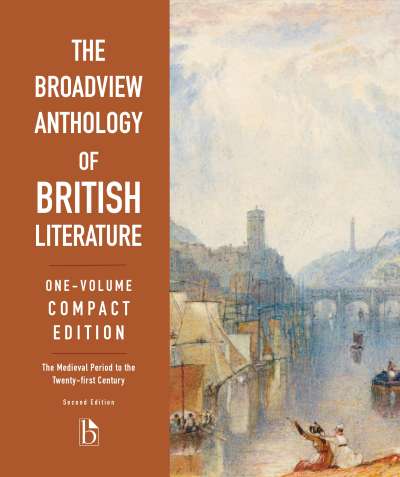
Guided by the latest scholarship, The Broadview Anthology of British Literature is acclaimed for its extraordinarily high quality, for its breadth, and for the deep attention it pays to literature’s historical and cultural contexts. The Broadview is structured to meet the needs of today’s students, with an unparalleled selection of illustrations and contextual materials, accessible and engaging introductions, and full explanatory annotations.
The Compact Edition, Volume A: The Medieval Period to the Eighteenth Century is the first half of the shortest version of the anthology; it’s ideally suited for one-semester survey courses. A substantial website component is included, and many longer works are also available from the publisher in separate volumes (which may at the instructor’s request be bundled together with this anthology).
Learn more about The Broadview Anthology of British Literature on this page.
Comments
Comments on this edition:
“Sleek and pragmatic, The Broadview Anthology of British Literature, Compact Edition gathers the foundational texts essential to the British survey, together with an exciting selection of the overlooked and unsung, all economically introduced and annotated. Among its strengths are its translations of medieval literature: Liuzza’s Beowulf is elegant and accessible, and Winny’s Sir Gawain and Waters’s Marie de France are more faithful and readable than the translations now printed in the Norton. Paradise Lost appears in generous selections, and Dr. Faustus is included in full. Add to this a Shakespeare play of the instructor’s choice at no extra cost, not to mention the affordability of the book itself, and you have some idea of the merits of this anthology.” — David Adkins, Northwest Nazarene University
“a reliable, well-researched, organized ‘one-stop shop’ for British literature instructors.” — Matthew Childres, Western Piedmont Community College
“a wonderful compilation, carefully curated with the college survey student in mind.” — Cheryl Saba, Cape Fear Community College
“Three aspects set these volumes apart from their competitors: the strength of the introductory and contextual material, the well-written and thorough footnotes, and the incorporation of visuals. The editors have chosen texts with care, including authors of color as well as women writers. … Divided into clear sections devoted to specific literary periods, the anthology includes robust introductions to each era, which illuminate key facets of culture, language, and history.” — Dr. Jennifer Lodine-Chaffey, Montana State University Billings
Readings highlighted in gray are included on the anthology’s companion website.
THE MEDIEVAL PERIOD
INTRODUCTION TO THE MEDIEVAL PERIOD
- History, Narrative, Culture
- Before the Norman Conquest
- Celts in Medieval Britain and Ireland
- Roman Britain
- The Early English, c. 400–700
- Celtic Culture
- Celtic Christianity
- Early English Christianity
- Invasion and Unification
- After the Norman Conquest
- The Normans and Feudalism
- Henry II and an International Culture
- Wales, Scotland, Ireland: Norman Invasions and Their Aftermath
- The Thirteenth Century
- The English Monarchy
- Cultural Expression in the Fourteenth Century
- Fifteenth-Century Transitions
- Language and Prosody
HISTORY OF THE LANGUAGE AND OF PRINT AND MANUSCRIPT CULTURE
Bede
Early Irish Lyrics
- The First Satire
- [A Bé Find, in rega lim] Fair lady, will you go with me
- [Messe ocus Pangur Bán] Me and white Pangur
- [Is acher in gáith innocht] The wind is wild tonight
- [Techt do Róim] Going to Rome?
- The Lament of the Old Woman of Beare
Exeter Book Elegies
- The Wanderer
- The Wife’s Lament
- (further selections and audio selection)
The Dream of the Rood
Exeter Book Riddles
Beowulf
- IN CONTEXT: Background Material
- (audio selection)
Ælfric of Eynsham
The Four Branches of the Mabinogi
Fled Bricrenn, Bricriu’s Feast
Marie de France
- Bisclavret (The Werewolf)
- Lanval
Middle English Lyrics
- Sumer is icumen in
- Betwene Mersh and Averil
- I have a gentil cock
- I sing of a maiden
- Adam lay ibounden
- Of all creatures women be best
- (further selections)
THE CRISES OF THE FOURTEENTH CENTURY
- The Hundred Years’ War
- from Jean Froissart, Chronicles
- from Prince Edward, Letter to the People of London, 1356
- The Black Death
- from Ralph of Shrewsbury, letter, 17 August 1348
- from Henry Knighton, Chronicle
- The Uprising of 1381
- from Statute of Laborers (1351)
- from Jean Froissart, Chronicles, Account of a Sermon by John Ball
- from Henry Knighton, Chronicle
- (further selections)
Sir Orfeo
Sir Gawain and the Green Knight
- IN CONTEXT: Illustrations from the Original Manuscript
- (facing-column translation)
Geoffrey Chaucer
- To Rosemounde
- from The Canterbury Tales
- The General Prologue
- The Miller’s Prologue and Tale
- The Wife of Bath’s Prologue and Tale
- Chaucer’s Retraction
- (further selections from The Canterbury Tales)
- (facing-column translations of selections from The Canterbury Tales)
- (further selections)
Julian of Norwich
Margery Kempe
- from The Book of Margery Kempe
- The Proem
- The Preface
- from Book 1
- Chapter 1
- Chapter 2
- Chapter 3
- from Chapter 4
- Chapter 11
- (further selections from The Book of Margery Kempe)
RELIGIOUS AND SPIRITUAL LIFE
The Wakefield Master, The Second Shepherds’ Play
Everyman
Mankind
Sir Thomas Malory
- from Morte Darthur
- from Book 1: From the Marriage of King Uther unto King Arthur
- from Book 8: The Death of King Arthur
- (contextual material)
Gwerful Mechain
- Death and Judgement
- Poem to the vagina
- I’w gŵr am ei churo / To her husband for beating her
- (contextual material)
THE RENAISSANCE AND THE EARLY SEVENTEENTH CENTURY
INTRODUCTION TO THE RENAISSANCE AND THE EARLY SEVENTEENTH CENTURY
- Humanism
- Scientific Inquiry
- The Reformation in England
- Wales, Scotland, Ireland
- Edward VI, Mary I, and Elizabeth I
- Elizabeth I and Gender
- Homoeroticism and Cross-Dressing
- Economy and Society in the Sixteenth and Seventeenth Centuries
- Changing Social Classes
- “The Round Earth’s Imagined Corners”
- The Stuarts and the Civil Wars
- Literary Genres
- Literature in Prose and the Development of Print Culture
- Poetry
- The Drama
- The English Language in the Sixteenth and Seventeenth Centuries
HISTORY OF THE LANGUAGE AND OF PRINT CULTURE
Sir Thomas More
- [Note to Instructors: Utopia is among over 400 available editions from Broadview, any one of which may be packaged together with this anthology volume.]
William Tyndale
- Tyndale’s English Bible, King James Bible
- Genesis: Chapter 1
- (further selections)
Sir Thomas Wyatt
Henry Howard, Earl of Surrey
THE EARLY MODERN SONNET AND LYRIC
- Francesco Petrarch
- from Rime Sparse
- 134 (“Pace non trovo et non ò da far guerra”)
- 134 (“I find no peace and all my war is done”)
- 140 (“Love, that doth reign and live within my thought”)
- 140 (“The long love that in my thought doth harbour”)
- 164 (“Or che ’l ciel et la terra e ’l vento tace”)
- 164 (“Alas! so all things now do hold their peace”)
- 189 (“Passa la nave mia colma d’oblio”)
- 189 (“My galley chargèd with forgetfulness”)
- 190 (“Una candida cerva sopra l’erba”)
- 190 (“Whoso list to hunt, I know where is a hind”)
- 269 (“Rotta è l’alta colonna e ’l verde lauro”)
- 269 (“The pillar perished is whereto I leant”)
- Sir Thomas Wyatt
- Sonnet 31 (“Farewell, Love, and all thy laws forever”)
- Epigram 38 (“Alas, madam, for stealing of a kiss”)
- Ballad 80 (“They flee from me that sometime did me seek”)
- Henry Howard, Earl of Surrey
- So Cruel Prison How Could Betide
- Isabella Whitney
- The Admonition by the Author to All Young Gentlewomen, and to All Other Kinds of Maids Being in Love
- Sir Walter Ralegh
- The Nymph’s Reply to the Shepherd
- Mary Sidney Herbert, Countess of Pembroke
- Psalm 58: Si Vere Utique
- Even now that care
- William Shakespeare
- from Romeo and Juliet (Act 1, Scene 5)
- Ben Jonson
- To John Donne
- On My First Son
- Song: To Celia
- To the Memory of My Beloved, the Author, Mr. William Shakespeare
- Robert Herrick
- Delight in Disorder
- To the Virgins, to Make Much of Time
- Andrew Marvell
- To His Coy Mistress
- The Mower against Gardens
- Margaret Cavendish
- Of Many Worlds in This World
- A World in an Earring
- Of the Theme of Love
- (further selections)
LITERATURE IN IRELAND, SCOTLAND, AND WALES
Edmund Spenser
- from The Faerie Queene
- from Book 1
- (further selections from The Faerie Queene)
- from Amoretti
- 1 (“Happy ye leaves when as those lilly hands”)
- 15 (“Ye tradefull Merchants, that with weary toyle”)
- 22 (“This holy season fit to fast and pray”)
- 34 (“Lyke as a ship that through the Ocean wyde”)
- 37 (“What guyle is this, that those her golden tresses”)
- 54 (“Of this worlds Theatre in which we stay”)
- 64 (“Comming to kisse her lyps, [such grace I found]”)
- 67 (“Lyke as a huntsman after weary chace”)
- 68 (“Most glorious Lord of lyfe that on this day”)
- 69 (“The famous warriors of the anticke world”)
- 75 (“One day I wrote her name upon the strand”)
- (further selections from Amoretti)
- (further selections and contextual material)
Sir Philip Sidney
- from Astrophil and Stella
- 1 (“Loving in truth, and fain in verse my love to show”)
- 2 (“Not at first sight, nor with a dribbèd shot”)
- 7 (“When Nature made her chief work, Stella’s eyes”)
- 20 (“Fly, fly, my friends, I have my death wound; fly!”)
- 31 (“With how sad steps, oh Moon, thou climb’st the skies”)
- 34 (“Come, let me write. ‘And to what end?’ To ease”)
- 39 (“Come, Sleep! O Sleep, the certain knot of peace”)
- 48 (“Soul’s joy, bend not those morning stars from me”)
- 52 (“A strife is grown between Virtue and Love”)
- 94 (“Grief find the words, for thou hast made my brain”)
- 108 (“When Sorrow [using mine own fire’s might]”)
- (further selections from Astrophil and Stella)
- (further selections and contextual material)
Elizabeth I, Queen of England
- Written in Her French Psalter
- The Doubt of Future Foes
- On Monsieur’s Departure
- When I Was Fair and Young
- To the Troops at Tilbury
- The Golden Speech
- (further selections and contextual material)
CULTURE: A PORTFOLIO
Aemilia Lanyer
- To the Virtuous Reader
- from Salve Deus Rex Judæorum
- “Invocation”
- “Eve’s Apology in Defense of Women”
- The Description of Cooke-ham
- To the Doubtful Reader
Sir Walter Ralegh
OTHER LANDS, OTHER CULTURES
Francis Bacon
Christopher Marlowe
- The Passionate Shepherd to His Love
- The Tragical History of Doctor Faustus (“A” Text)
- (further selections and contextual material)
THE SUPERNATURAL AND THE OCCULT
- from Heinrich Cornelius Agrippa, De Occulta Philosophia (Of Occult Philosophy)
- from Reginald Scot, The Discovery of Witchcraft
- from George Gifford, A Discourse of the Subtle Practices of Devils by Witches and Sorcerers
- from William Perkins, A Discourse of the Damned Art of Witchcraft
- from Joseph Hall, Characters of Virtues and Vices
- Anonymous Broadsheet, “The Form and Shape of a Monstrous Child”
William Shakespeare
- Sonnets
- 1 (“From fairest creatures we desire increase”)
- 2 (“When forty winters shall besiege thy brow”)
- 18 (“Shall I compare thee to a summer’s day?”)
- 19 (“Devouring time, blunt thou the lion’s paws”)
- 20 (“A woman’s face with nature’s own hand painted”)
- 29 (“When in disgrace with fortune and men’s eyes”)
- 30 (“When to the sessions of sweet silent thought”)
- 33 (“Full many a glorious morning have I seen”)
- 55 (“Not marble, nor the gilded monuments”)
- 57 (“Being your slave, what should I do but tend”)
- 58 (“That god forbid, that made me first your slave”)
- 60 (“Like as the waves make towards the pebbled shore”)
- 64 (“When I have seen by time’s fell hand defaced”)
- 65 (“Since brass, nor stone, nor earth, nor boundless sea”)
- 71 (“No longer mourn for me when I am dead”)
- 73 (“That time of year thou mayst in me behold”)
- 87 (“Farewell—thou art too dear for my possessing”)
- 94 (“They that have power to hurt and will do none”)
- 116 (“Let me not to the marriage of true minds”)
- 127 (“In the old age black was not counted fair”)
- 129 (“Th’expense of spirit in a waste of shame”)
- 130 (“My mistress’ eyes are nothing like the sun”)
- 138 (“When my love swears that she is made of truth”)
- 143 (“Lo, as a careful housewife runs to catch”)
- 144 (“Two loves I have, of comfort and despair”)
- 146 (“Poor soul, the centre of my sinful earth”)
- 147 (“My love is as a fever, longing still”)
- IN CONTEXT: The Shakespearean Theater
- (further selections and contextual material)
- [Note to Instructors: To facilitate instructor choice, we have included Twelfth Night, A Midsummer Night’s Dream, The Merchant of Venice, and King Lear in the anthology’s online component. Broadview also offers standalone editions of any of the Shakespeare plays listed above—and of several others, including Hamlet and Othello—any of whichmay be packaged together with this anthology volume.]
Ben Jonson
John Donne
- from Songs and Sonnets
- The Good-Morrow
- Song (“Go, and catch a falling star”)
- The Sun Rising
- The Canonization
- The Flea
- The Bait
- A Valediction: Forbidding Mourning
- from Elegies
- Elegy 19: To His Mistress Going to Bed
- from Holy Sonnets
- 10 (“Death be not proud, though some have called thee”)
- 14 (“Batter my heart, three personed God; for you”)
- A Hymn to God the Father
- Hymn to God, My God, in My Sickness
- from Devotions
- (further selections)
Lady Mary Wroth
- from Pamphilia to Amphilanthus
- 1 (“When night’s black mantle could most darkness prove”)
- 6 (“My pain, still smothered in my grieved breast”)
- 7 (“Love leave to urge, thou know’st thou hast the hand”)
- 13 (“Dear, famish not what you yourself gave food”)
- 14 (“Am I thus conquered? Have I lost the powers”)
- 15 (“Truly poor Night thou welcome art to me”)
- 22 (“Like to the Indians, scorched with the sun”)
- 23 (“When every one to pleasing pastime hies”)
- 35 (“False hope which feeds but to destroy, and spill”)
- from A Crown of Sonnets Dedicated to Love
- 77 (“In this strange labyrinth how shall I turn?”)
- 78 (“Is to leave all, and take the thread of love”)
- 89 (“Free from all fogs, but shining fair, and clear”)
- 90 (“Except my heart, which you bestowed before”)
- Railing Rhymes Returned upon the Author by Mistress Mary Wroth
- IN CONTEXT: The Occasion of “Railing Rhymes”
- Edward Denny, Baron of Waltham, “To Pamphilia from the Father-in-Law of Seralius”
Thomas Hobbes
Robert Herrick
George Herbert
- The Altar
- Redemption
- Easter Wings
- Prayer (1)
- Jordan (1)
- Time
- The Collar
- The Pulley
- Discipline
- Love (3)
- (further selections)
Andrew Marvell
Katherine Philips
- A Married State
- Upon the Double Murder of King Charles
- To My Excellent Lucasia, on Our Friendship
- Friendship’s Mystery, To My Dearest Lucasia
- Friendship in Emblem, or the Seal, To My Dearest Lucasia
- (further selections)
John Milton
- L’Allegro
- Il Penseroso
- Sonnets
- 18: On the Late Massacre in Piedmont
- 19 (“When I consider how my light is spent”)
- 23 (“Methought I saw my late espoused saint”)
- from Paradise Lost
- The Verse
- Argument to Book 1
- Book 1
- Argument to Book 2
- Book 2
- Argument to Book 4
- Book 4
- Argument to Book 9
- Book 9
- Argument to Book 10
- Book 10
- Argument to Book 12
- from Book 12
- (further selections from Paradise Lost)
- IN CONTEXT: Illustrating Paradise Lost
- (further selections)
THE RESTORATION AND THE EIGHTEENTH CENTURY
INTRODUCTION TO THE RESTORATION AND THE EIGHTEENTH CENTURY
- Religion, Government, and Party Politics
- Empiricism, Skepticism, and Religious Dissent
- The Enlightenment / “The Age of Reason”
- Industry, Commerce, and the Middle Class
- Ethical Dilemmas in a Changing Nation
- Print Culture
- Poetry
- Theater
- The Novel
- The Development of the English Language
HISTORY OF THE LANGUAGE AND OF PRINT CULTURE
John Dryden
- Mac Flecknoe
- To the Memory of Mr. Oldham
- (further selections)
Samuel Pepys
Aphra Behn
- The Disappointment
- Oroonoko: or, The Royal Slave. A True History
- (further selections)
- [Note to Instructors: To facilitate instructor choice, the anthology’s online component offers multiple works of Restoration and eighteenth-century comedy, including Behn’s The Rover, Wycherley’s The Country Wife, and Sheridan’s The School for Scandal. Any of Broadview’s standalone editions are also available for packaging with this anthology volume.]
William Wycherley
John Wilmot, Earl of Rochester
- A Satire on Charles II
- The Imperfect Enjoyment
- Impromptu on Charles II
- (further selections and contextual material)
Daniel Defoe
- from A Journal of the Plague Year
- (further selections and contextual material)
Anne Finch, Countess of Winchilsea
Jonathan Swift
- A Description of a City Shower
- Stella’s Birthday, written in the year 1718
- The Lady’s Dressing Room
- from Gulliver’s Travels
- Part 1: A Voyage to Lilliput
- (complete text of Gulliver’s Travels)
- A Modest Proposal
- IN CONTEXT: Sermons and Tracts: Backgrounds to A Modest Proposal
- from Jonathan Swift, “Causes of the Wretched Condition of Ireland”
- from Jonathan Swift, A Short View of the State of Ireland
- (further selections)
THE ENLIGHTENMENT
Alexander Pope
- from An Essay on Criticism
- The Rape of the Lock: An Heroi-Comical Poem in Five Cantos
- from An Essay on Man
- The Design
- Epistle 1
- from Epistle 2
Lady Mary Wortley Montagu
- The Reasons that Induced Dr. S. to Write a Poem Called The Lady’s Dressing Room
- from The Turkish Embassy Letters
- (further selections)
Eliza Haywood
- Fantomina: or, Love in a Maze
- (contextual material)
PRINT CULTURE, STAGE CULTURE
James Thomson
Samuel Johnson
- from The Rambler
- No. 4 [On Fiction] (31 March 1750)
- from The Idler
- No. 81 [On Native Americans] (3 November 1759)
- from A Dictionary of the English Language
- from The Preface
- Selected Entries
- (further selections)
Thomas Gray
- Elegy Written in a Country Churchyard
Christopher Smart
Olaudah Equiano or Gustavus Vassa
- from The Interesting Narrative of the Life of Olaudah Equiano
- from Chapter 1
- Chapter 2
- (further selections from The Interesting Narrative)
- IN CONTEXT: Reactions to Olaudah Equiano’s Work
- from The Analytic Review (May 1789)
- from The Gentleman’s Magazine (June 1789)
- from The Monthly Review (June 1789)
- from The General Magazine and Impartial Review (July 1789)
EMPIRE AND ENTERPRISE
Richard Brinsley Sheridan
Phillis Wheatley
- To Maecenas
- On Being Brought from Africa to America
- To the Right Honourable William, Earl of Dartmouth, His Majesty’s Principal Secretary of State for North-America
- To S.M., a Young African Painter, On Seeing His Works
APPENDICES
- Reading Poetry
- Maps
- Monarchs and Prime Ministers
- Glossary of Terms
- British Money
- Texts and Contexts: Chronological Chart
- Bibliography
- Permissions Acknowledgment
- Index of First Lines
- Index of Authors and Titles
General Editors:
Joseph Black, University of Massachusetts
Kate Flint, University of Southern California
Isobel Grundy, University of Alberta
Wendy Anne Lee, New York University
Don LePan, Broadview Press
Roy Liuzza, University of Tennessee
Jerome J. McGann, University of Virginia
Anne Lake Prescott, Barnard College
Jason R. Rudy, University of Maryland, College Park
Claire Waters, University of California, Davis
The Broadview Anthology of British Literature offers sites for both instructors and students.
The Online Resources Site, for both students and instructors, acts as an online component of the anthology itself, offering many hundreds of readings edited and formatted like those of the bound book, as well as some audio and video selections. The site also features useful study and background materials, including close to 200 interactive review questions; details on British currency; chronological charts; bibliographies; and more. An access code to the website is included with all new copies. If you purchased a used copy or are missing your passcode for this site, please click here to purchase a code online.
A separate Instructor Site features guides to key works and authors in the anthology, with approaches to teaching, background material, and discussion questions; the site also offers a list of anthology contents by theme and region. An access code to the website is included with all examination copies.