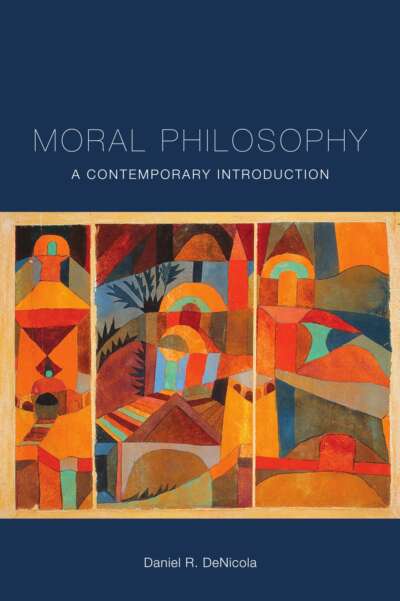
Moral Philosophy: A Contemporary Introduction – Second Edition
  • Publication Date: October 31, 2026
  • ISBN: 9781554817078 / 1554817072
  • 350 pages; 6" x 9"

Price for your region

Note on pricing.

Request Exam Copy

Examination copy policy

Availability: Worldwide

Moral Philosophy: A Contemporary Introduction – Second Edition

  • Publication Date: October 31, 2026
  • ISBN: 9781554817078 / 1554817072
  • 350 pages; 6" x 9"

Moral Philosophy: A Contemporary Introduction is a compact yet comprehensive book offering an explication and critique of the major theories that have shaped philosophical ethics. DeNicola explores the scope, limits, and requirements of morality, outlining our various attempts to ground it: in religion, in nature, in culture, in social contracts, and in aspects of the human person such as reason, emotions, caring, and intuition. Discussion questions, suggested readings, and a glossary are included to facilitate deeper engagement.

This second edition includes a new chapter discussing existentialist and postmodernist ethics as well as standpoint theory and intersectionality. This chapter examines the ideas of Friedrich Nietzsche, Jean-Paul Sartre, Jacques Derrida, Kimberlé Crenshaw, and others. Other chapters are also revised and expanded: several new case studies have been added, as have discussions of effective altruism, universalist care ethics, and the views of Charles Mills and Carole Pateman.

Comments

Comments on previous edition

“Using DeNicola’s Moral Philosophy: A Contemporary Introduction has transformed my undergraduate ethical theory course: for the first time, I have a textbook that presents material at exactly the right level of complexity, and keeps the students engaged and enthusiastic about what they are learning. The cases that open each chapter capture students’ attention, and the questions at the end of each chapter lead to sophisticated and lively discussions. The book covers each ethical theory in a way that goes beyond the basics and into the most interesting and controversial implications that the theory may have, encouraging students to think critically and complexly as they are developing their own philosophical positions.” — Lisa Tessman, Binghamton University

“DeNicola provides an introduction to moral philosophy that I am excited to offer to my undergraduate students. The cases for each chapter motivate critical interrogation of the scope and limits of each theory while grounding theory in practice. This book carefully articulates a breadth of moral philosophy sorely lacking from most introductory texts, offering critical discussion reflecting contemporary approaches that are at once inclusive and expansive.” — Sylvia Burrow, Cape Breton University

“With this text, DeNicola has produced a clear introduction to philosophical ethics that strikes a skillful balance between the expectations of the instructor and the needs of the student. DeNicola’s text is comprehensive and readable, yet challenging enough to engage the serious student.” — Bradley Morris, North Dakota State University

Preface and Acknowledgments

Chapter 1: Ethical Theory, Moral Concerns

  • 1.1 Morality and Life
  • 1.2 The Value of Ethical Study
  • 1.3 The Moral Sphere
  • 1.4 Identifying the Moral
  • 1.5 Philosophical Ethics
  • 1.6 Evaluation of Ethical Theories
  • 1.7 Cases, Thought-Experiments, and Counterexamples
  • 1.8 The Point of It All
  • 1.9 Sources of Moral Values

Chapter 2: Morality and Religion

  • 2.1 The Religious Context
  • 2.2 Religion and Morality
  • 2.3 Divine Command Theory
  • 2.4 Implications
  • 2.5 Critique of Divine Command Theory
  • 2.6 The Two Faces of Religion
  • 2.7 Ethics without God

Chapter 3: Relativism

  • 3.1 Forms of Relativism
  • 3.2 Moral Cultural Relativism
  • 3.3 Critique of Cultural Relativism
  • 3.4 Subjectivism
  • 3.5 Honor-Shame Cultures
  • 3.6 Relativism and Pluralism

Chapter 4: Moral Naturalism

  • 4.1 The Natural and the Good
  • 4.2 Pre-Modern Advocates of Naturalism
  • 4.3 Contemporary Advocates of Naturalism
  • 4.4 Import and Critique of Naturalism and Natural Law
  • 4.5 Unnatural Practices
  • 4.6 Natural Rights
  • 4.7 A Critique of Natural Rights
  • 4.8 Human Capabilities
  • 4.9 Humanity and Morality

Chapter 5: Egoism

  • 5.1 Our Natural Self-Interest
  • 5.2 Psychological Egoism: A Critique
  • 5.3 The Self and Homo economicus
  • 5.4 Evidence and Altruism
  • 5.5 Ethical Egoism
  • 5.6 Testing Egoism as a Moral Theory
  • 5.7 Enlightened Self-Interest

Chapter 6: Utilitarianism

  • 6.1 The Right and the Good
  • 6.2 From Egoism to Utilitarianism
  • 6.3 Bentham’s Calculus
  • 6.4 John Stuart Mill
  • 6.5 Qualitative Hedonism
  • 6.6 The Proof of Utility
  • 6.7 From Acts to Rules
  • 6.8 The Adequacy and Impact of Utilitarianism

Chapter 7: Kantianism

  • 7.1 Preview
  • 7.2 Good Will
  • 7.3 Duty and Imperatives
  • 7.4 The Categorical Imperative
  • 7.5 Alternative Formulations of the Categorical Imperative
  • 7.6 The Import of Kantian Ethics
  • 7.7 Critique of Kantian Ethical Theory

Interlude: Principled Ethics

Chapter 8: Contractarianism

  • 8.1 The Moral and the Legal
  • 8.2 Contracts and Consent
  • 8.3 Social Contract Theory
  • 8.4 John Rawls and the Just State
  • 8.5 Morality by Contract
  • 8.6 Critique of Contractualism
  • 8.7 Dissent, Violation, and Reform

Chapter 9: Virtue Ethics

  • 9.1 Moral Theory and Human Relationships
  • 9.2 Character: An Ethic of Virtues and Vices
  • 9.3 Confucian Ethics
  • 9.4 Aristotle and Our Summum Bonum
  • 9.5 Aristotelian Virtues
  • 9.6 MacIntyre and the Revival of Virtue Ethics
  • 9.7 A Commentary on Virtue Ethics
  • 9.8 Challenges to Virtue Ethics
  • 9.9 The Virtues of Virtue Ethics

Chapter 10: Emotions and Moral Sentiment Theory

  • 10.1 The Nature of Emotion
  • 10.2 Emotionality and Morality
  • 10.3 Moral Sentiment Theory
  • 10.4 David Hume’s Moral Theory
  • 10.5 Adam Smith on Sympathy and Moral Judgment
  • 10.6 Smith’s Impartial Spectator
  • 10.7 The Case of Disgust
  • 10.8 Commentary and Critique

Chapter 11: Care Ethics and the Feminist Standpoint

  • 11.1 Stages of Moral Reasoning
  • 11.2 Different Voices: From Gilligan to Kittay
  • 11.3 Situating Care Ethics
  • 11.4 Critique of Care Ethics
  • 11.5 Prospects for a Universal Care Ethics
  • 11.6 Commentary and Critique

Chapter 12: Particularism and Intuitionism

  • 12.1 From Scenarios to Moral Epistemology
  • 12.2 Taking Notice
  • 12.3 Particularism, Principles, and Perception
  • 12.4 Ethical Intuitionism
  • 12.5 Critique and Rebuttal
  • 12.6 The Social Intuitionist Model
  • 12.7 Concluding Reflections

Chapter 13: From Nietzsche to the Ethics of Identity

  • 13.1 Nietzsche: Beyond Good and Evil
  • 13.2 Existentialism
  • 13.3 Postmodernism
  • 13.4 Contrasts with Modernity
  • 13.5 Standpoint Theory
  • 13.6 Critique

Chapter 14: Metaethics

  • 14.1 Moral Judgments and Disagreement
  • 14.2 Cognitivism
  • 14.3 Facts and Values
  • 14.4 Non-Cognitivism and Moral Anti-Realism
  • 14.5 Emotivism and Prescriptivism
  • 14.6 Critique of Non-Cognitivism
  • 14.7 Error Theory and Non-Naturalism
  • 14.8 The Ground of Morality

Chapter 15: Moral Theory and the Good Life

  • 15.1 Moral Saints and Prophets
  • 15.2 Good Enough
  • 15.3 Decency, Flourishing, and Morality’s Demands
  • 15.4 Moral Repair
  • 15.5 Impossible Choices
  • 15.6 The Role and Limits of Moral Theory

Glossary

Index

Daniel R. DeNicola is Professor Emeritus of Philosophy and former Provost at Gettysburg College. He is the editor of A Reader in Moral Philosophy, and author of Learning to Flourish: A Philosophical Exploration of Liberal Education and Understanding Ignorance: The Surprising Impact of What We Don’t Know, winner of the 2018 PROSE Award in Philosophy. Visit drdenicola.com for more information.

Key Features of Moral Philosophy: A Contemporary Introduction

  • • A compact yet comprehensive introduction to ethical theory
  • • Clear and readable, without watering down the complexity of the theories and arguments at issue
  • • Provides insightful discussions of the meaning and status of ethical claims as well as the role and limits of morality in a flourishing life
  • • Offers the reader a set of criteria for evaluating moral theories, as well as the goal of reflective equilibrium
  • • Each chapter begins with a provocative real case or fictional scenario designed to illustrate the issues at hand
  • • Includes two types of questions:
    • Questions for Discussion, which ask for analysis and explanation of the chapter’s content
    • Reflective Questions, which propose deeper and more personal inquiries
  • • A glossary of key terms is provided as an appendix

New to this 2nd Edition

  • • An added chapter (13) examines existentialist and postmodernist thought, discussing the ideas of Friedrich Nietzsche, Jean-Paul Sartre, Jacques Derrida, Kimberlé Crenshaw, and others.
  • • Chapter 6 now includes treatment of Peter Singer and the Effective Altruism movement.
  • • Chapter 8 discusses the views of Carole Pateman and Charles Mills.
  • • Expanded treatment of Michael Slote’s universalist care ethics in chapter 11.
  • • Six all-new chapter-opening case studies.

Moral Philosophy has a companion website for instructors, which provides multiple-choice quizzes and PowerPoint slides for each chapter of the text.