
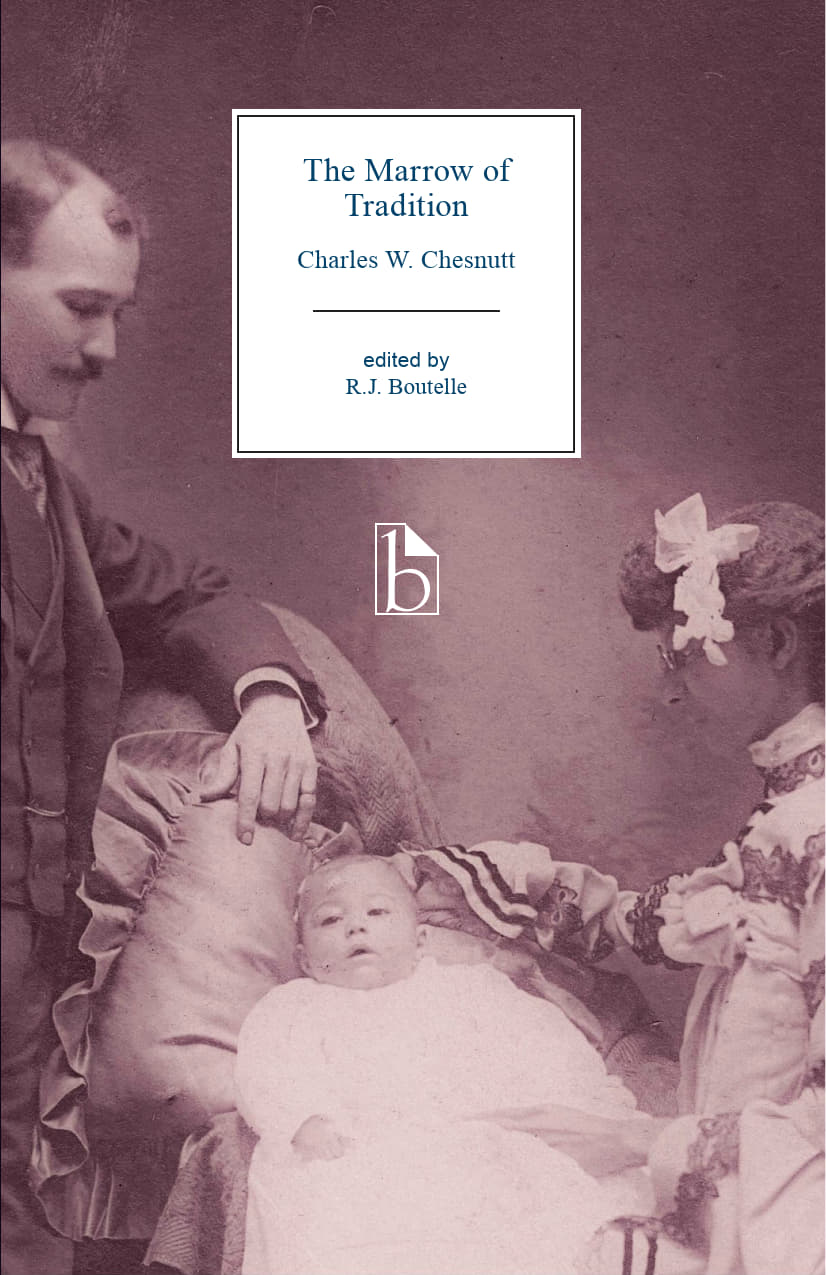
An emotional tour de force, Charles W. Chesnutt’s The Marrow of Tradition (1901) unfolds against the backdrop of the only successful coup d’état in US history—the 1898 Wilmington Massacre. The novel combines domestic dramas, political scheming, and social commentary as it documents white supremacists’ violent “redemption” of a majority Black city. By following two interrelated families—the white Carterets and the Black Millers—through these harrowing events, The Marrow of Tradition offers intimate insights into the complexities of life on the color line. Equal parts comedic, romantic, political, and tragic, the novel probes the depths and artifice of race relations in the US.
The Marrow of Tradition
Coming Soon
Price for your region
The Marrow of Tradition
Appendix A: Composition and Reception
- 1. Charles Chesnutt, “Plot Notes” (1900)
- 2. Charles Chesnutt to Walter Hines Page (11 November 1898)
- 3. William Dean Howells, “A Psychological Counter-current in Recent Fiction” (1901)
- 4. T. Thomas Fortune, review in The Colored American (30 November 1901)
- 5. “The ‘Wellington’ Revolution,” Wilmington Messenger (10 January 1902)
- 6. Review in Cleveland Gazette (16 May 1903)
II. Related Essays and Short Fiction
- 1. Charles W. Chesnutt, “The Goophered Grapevine,” The Atlantic Monthly (August 1887): 254-60.
- 2. Charles W. Chesnutt, “The Web of Circumstance,” in The Wife of His Youth and Other Stories of the Color Line (Boston and New York: Houghton, Mifflin and Company, 1899): 291-323.
- 3. Charles W. Chesnutt, “What is a White Man?,” The Independent, 30 May 1889.
- 4. Charles W. Chesnutt, “The Passing of Grandison,” in The Wife of His Youth and Other Stories of the Color Line (Boston and New York: Houghton, Mifflin and Company, 1899): 168-202.
- 5. Charles W. Chesnutt, “The Future American: What the Race is Likely to Become in The Process of Time,” Boston Evening Transcript, 18 August 1900.
- 6. Charles W. Chesnutt, “The Future American: A Stream of Dark Blood in the Veins of the Southern Whites,” Boston Evening Transcript, 25 August 1900.
- 7. Charles W. Chesnutt, “The Future American: A Complete Race-Amalgamation Likely to Occur,” Boston Evening Transcript, 1 September 1900.
- 8. Charles W. Chesnutt, “The Negro’s Franchise,” Boston Evening Transcript, 11 May 1901.
- 9. Charles W. Chesnutt, “The Free Colored People of North Carolina,” Southern Workman (March 1902).
- 10. Charles W. Chesnutt, “The Disfranchisement of the Negro,” in The Negro Problem, ed. Booker T. Washington (New York: J. Pott & Company, 1903): 77-124).
- 11. Charles W. Chesnutt, “The Marked Tree,” The Crisis (December 1924; January 1925): 59-64; 110-13.
III. Reviews
- 1. Charles Chesnutt’s “Own View of His New Story,” Cleveland World (20 October 1901)
- 2. W. W. H., “The Marrow of Tradition, C. W. Chesnutt,” Modern Culture (1 November 1901): 260-261.
- 3. “The Marrow of Tradition,” The Worchester Magazine (November 1901): 169.
- 4. New York Press, 2 November 1901.
- 5. “From the Negro Side,” The Illustrated Buffalo Express, 3 November 1901.
- 6. The Brooklyn Daily Eagle, 9 November 1901.
- 7. “The Marrow of Tradition,” The Evening Star, 9 November 1901.
- 8. Hamilton Wright Mabie, “[Review of The Marrow of Tradition],” The Outlook 69 (16 November 1901).
- 9. “The Marrow of Tradition,” The Beacon, 16 November 1901.
- 10. “The Marrow of Tradition,” Boston Courier, 16 November 1901.
- 11. “A Bundle of New Novels,” Providence Daily Journal, 17 November 1901.
- 12. “The Marrow of Tradition,” The Portland Weekly Advertiser, 19 November 1901.
- 13. “A Powerful Story,” The Chicago Daily Tribune, 20 November 1901.
- 14. “The Marrow of Tradition,” The St. Paul Globe, 20 November 1901.
- 15. The Daily Time, 22 November 1901.
- 16. “ The Marrow of Tradition,” The Southern Workman 30 (December 1901): 695-696.
- 17. John Livingston Wright, “One of the Leading Novelists of the Race,” Colored American Magazine 4 (4 December 1901): 153-156.
- 18. “The Marrow of Tradition,” Zion’s Herald, 4 December 1901.
- 19. The Appeal, 7 December 1901.
- 20. “A Story of Race Conflict,” The Congregationalist and Christian World 86 (7 December 1901): 897-898.
- 21. “The Marrow of Tradition,” The Watchman, 12 December 1901.
- 22. “A New Uncle Tom’s Cabin,” St. Paul Dispatch, 14 December 1901.
- 23. The Times, 15 December 1901.
- 24. The Daily States, 15 December 1901.
- 25. Friends’ Intelligencer, 21 December 1901.
- 26. “The Marrow of Tradition,” The Freeman, 28 December 1901.
- 27. Town and Country 56 (28 December 1901).
- 28. “Mr Chesnutt and the Negro Problem,” Newark Sunday News, 29 December 1901.
- 29. “The Marrow of Tradition,” The Herald and Presbyter, 8 January 1902.
- 30. Charles Alexander, “Our Journalists and Literary Folks,” The Freeman, 18 January 1902.
- 31. The Seattle Post-Intelligencer, 19 January 1902.
- 32. Charles Curtz Hahn, “Books,” Sunday World-Herald, 26 January 1902.
- 33. “Charles W. Chesnutt’s Books,” The Appeal, 1 February 1902.
- 34. The Public 4 (1 February 1902).
- 35. “The Marrow of Tradition,” World’s Work 3 (February 1902): 1788.
- 36. “The Marrow of Tradition,” Independent, 6 March 1902.
- 37. “Three Novels of Nowadays,” The Country Gentleman 67 (13 March 1902): 228
- 38. “Six Novels,” The Evening Post, 22 March 1902.
- 39. “The Marrow of Tradition,” The Phonographic Magazine 16 (April 1902): 96.
- 40. “Two Strong Men of the Race,” The Tuskegee Student, 5 April 1902.
- 41. “‘The Marrow of Tradition,’” The Argonaut, 5 May 1902.
- 42. “The Marrow of Tradition,” The Broad Ax, 26 July 1902.
- 43. Charles Alexander, “[Review of The Marrow of Tradition],” The Cleveland Journal, 23 May 1903.
- 44. The New York Age, 20 July 1905.
Appendix B: Black Progress and White Backlash in the Post-Reconstruction Era
- 1. Henry McNeal Turner, from The Barbarous Decision of the United States Supreme Court (1893)
- 2. T. Thomas Fortune, from Black and White: Land, Labor and Politics in the South (1884)
- 3. Booker T. Washington, “The Atlanta Exposition Address” (1896)
- 4. W. E. B. DuBois, from “The Talented Tenth” (1903)
Related products
-
The Adventures of Tom Sawyer
-
Martin R. Delany: Selected Writings
-
Adventures of Huckleberry Finn
-
Hagar’s Daughter
-
Herland and Related Writings
-
Incidents in the Life of a Slave Girl
-
Secret History; or, The Horrors of St. Domingo and Laura
-
The Pedro Gorino
-
Lynn Riggs: The Indigenous Plays
-
The Call of the Wild
-
An Imperative Duty
-
Frederick Douglass: Selected Writings and Speeches