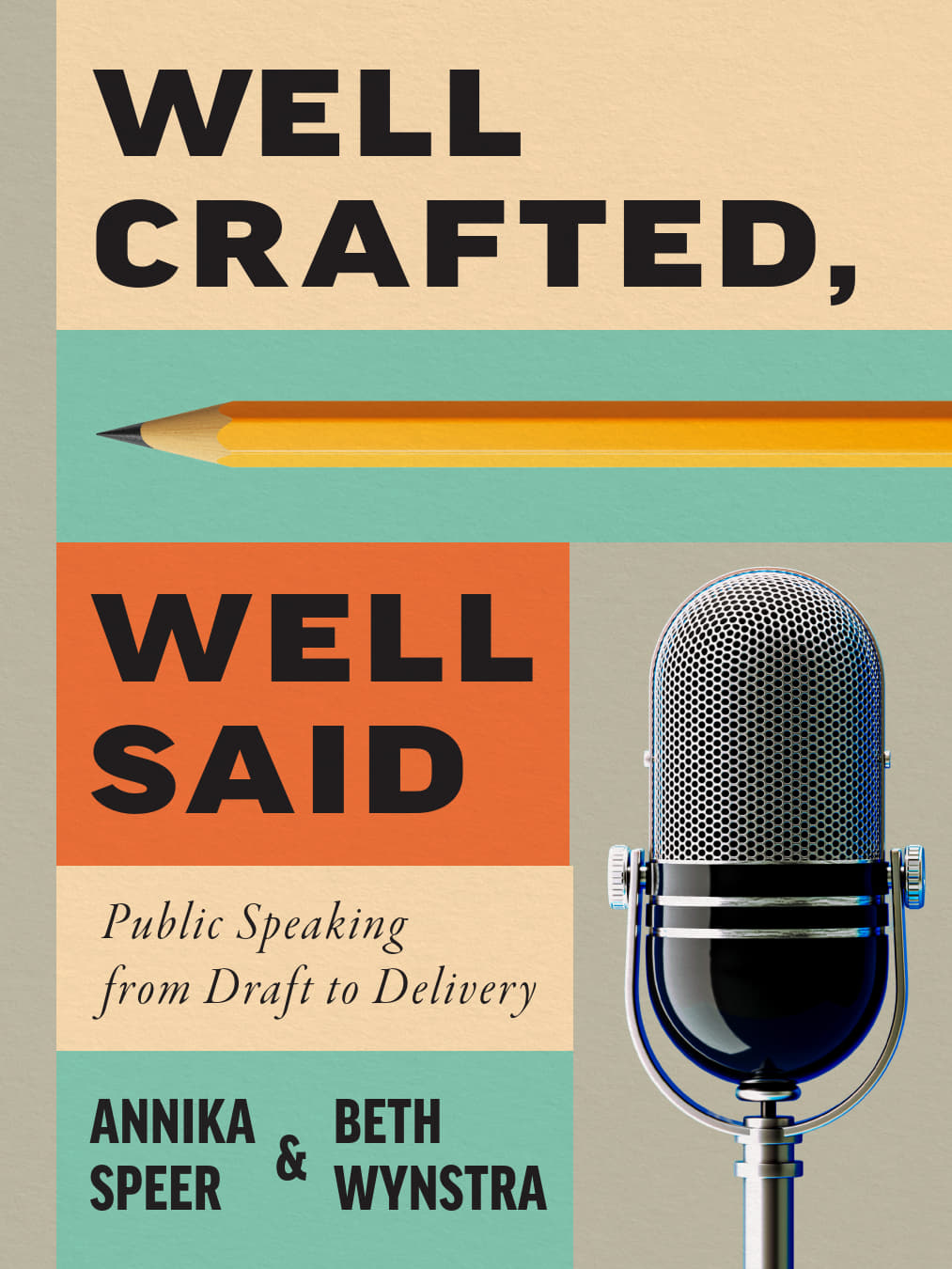
Well Crafted, Well Said
Public Speaking from Draft to Delivery
  • Publication Date: December 15, 2026
  • ISBN: 9781554816392 / 1554816394
  • 450 pages; 7" x 9"

Price for your region

Note on pricing.

Request Exam Copy

Examination copy policy

Availability: Worldwide

Well Crafted, Well Said

Public Speaking from Draft to Delivery

  • Publication Date: December 15, 2026
  • ISBN: 9781554816392 / 1554816394
  • 450 pages; 7" x 9"

Well Crafted, Well Said is a public speaking textbook organized around the full arc of effective speaking, from listening and self-awareness through preparation, organization, and delivery. Hands-on instruction is provided with encouragement, optimism, and keen attention to the student experience.

The authors incorporate a variety of contemporary speaking examples from diverse voices so that students can seamlessly relate their classroom learning to the public sphere. Chapters on storytelling, introductions and conclusions, and shaping language connect directly to applied practice across a broad range of speech types. Throughout, the authors emphasize the relationship between preparation and delivery, helping students develop speeches—and speaking habits—that they can carry with them into any academic, professional, or public setting.

An Instructors’ Resources site includes lecture PowerPoints, quizzes for every chapter, and editable assessment rubrics.

Introduction

Part I – You, the Speaker: Preparing Yourself as a Performer

Chapter 1: Listening to Yourself and Others

  • Listening to Others and the Importance of Empathy
  • Listening to Yourself (Internally)
  • Listening to Yourself (Externally)

Chapter 2: Preparing Your Voice

  • Distinctive Voices
  • Breath and the Body
  • Using Your Breath
  • Vocal Anatomy

Chapter 3: Managing Speaking Anxiety

  • Breaking Down the Fear of Public Speaking
  • Facing the Fear: Preparing to Speak
  • Embrace the Anxiety
  • Take Time to Warm Up and Breathe
  • Understand Your Environment
  • Decide What You Have Control Over…and What You Do Not
  • Enjoy Your Unique Presence and Power as a Speaker

Chapter 4: Knowing Yourself and Your Audience

  • Timing
  • One Person’s Timing May Not Be Another Person’s Timing
  • Audience Demographics: More Than a Checklist
  • Audience: Voluntary or Captive?
  • Audience Analysis
  • Knowing your Audience in Action

Part II – Fundamentals: Crafting Your Content

Chapter 5: Western Rhetoric, An Overview

  • Ideas from the Ancient World: Aristotle and Cicero
  • Example Speech: Combining Ethos, Pathos, and Logos
  • Cicero’s Five Canons of Rhetoric

Chapter 6: Researching Your Speech

  • Understanding Types of Source Material
  • Finding Credible Source Material
  • Conducting Your Research
  • Using Your Research
  • Speech Outline
  • Delivering Your Research
  • Ethical Considerations

Chapter 7: Storytelling

  • Why Stories?
  • What Story Do You Want to Tell?
  • The K.I.S.S. of Stories
  • Where to Place Your Story
  • Stories Come Alive with Delivery

Chapter 8: Organizing Your Speech

  • Organizing the Body of Your Speech
  • Arrangement is a Creative Opportunity!

Chapter 9: Crafting Introductions and Conclusions

  • Opening Lines: Introducing the Introduction
  • To Provide a Content Warning, or Not to Provide a Content Warning
  • Conclusions: Ending as Strong as You Start

Chapter 10: Shaping Your Message

  • Assessing Diction for Your Audience
  • Positive and Negative Connotations
  • Incorporating Imagery
  • Employing Rhetorical Devices

Part III – Delivery, Delivery, Delivery: Your Embodied Performance

Chapter 11: Vocalizing Your Message

  • Subtext
  • Pitch
  • Volume
  • Rate
  • The Power of the Pause
  • Tone
  • Subtext in the Public Sphere

Chapter 12: Using Your Space

  • The In-Person (Embodied) Presentation
  • Preparing for Virtual Spaces
  • The (Dis)embodied Presentation

Chapter 13: Designing Your Presentation

  • Presenting with Visuals
  • Presenting with Images
  • Presenting with Data
  • To Animate or Not to Animate

Part IV – The Speeches

Chapter 14: Persuasive Speaking

  • Persuasion is Everywhere
  • Rhetorical Integration and Impact
  • The What and How of Persuasive Speaking
  • Monroe’s Motivated Sequence

Chapter 15: Informational Speaking

  • Descriptive Speeches
  • Demonstrative Speeches
  • Definitive Speeches
  • Explanatory Speeches

Chapter 16: Ceremonial Speaking

  • Toasts
  • Eulogies
  • Introducing a Speaker
  • Presenting an Award
  • Accepting an Award
  • Commencement Addresses

Chapter 17: Political Speaking

  • Future Action, with the Past and Present
  • Common Topics
  • Places and Spaces of Your Audience
  • Paths for Action
  • Memorable Delivery, Not Infamous Delivery

Chapter 18: Pitching

  • The Opportunity, the Market, the Model
  • What Audiences Need to Hear
  • Pitch Structures
  • A Significant Slogan

Chapter 19: Impromptu Speaking

  • Strategies for Speaking Off the Cuff

Annika Speer is Associate Professor and Director of the Public Speaking Initiative at University of California, Riverside. Beth Wynstra is Associate Professor and Faculty Director of the Center for Engaged Learning and Teaching at Babson College.

  • • Delivery treated as central to effective speaking and strongly emphasized throughout
  • • Extensive practice-based activities and exercises, from tongue twisters for articulation to audience analysis and applied speechwriting exercises
  • • Contemporary examples drawn from a diverse range of public speakers, including Malala Yousafzai, Hasan Minhaj, Bernie Sanders, Martin Luther King Jr., Oprah Winfrey, Monica Lewinsky, Amanda Forman, Abby Wambach, Naomi Wadler, and many others
  • • Dedicated attention to presentation design and speaking in online environments
  • • Pragmatic, ethical guidance on incorporating AI into the brainstorming process while prioritizing the humanistic value of public speaking and students’ own voices
  • • Instructors’ Resources include lecture PowerPoints and quizzes for every chapter, and editable rubrics