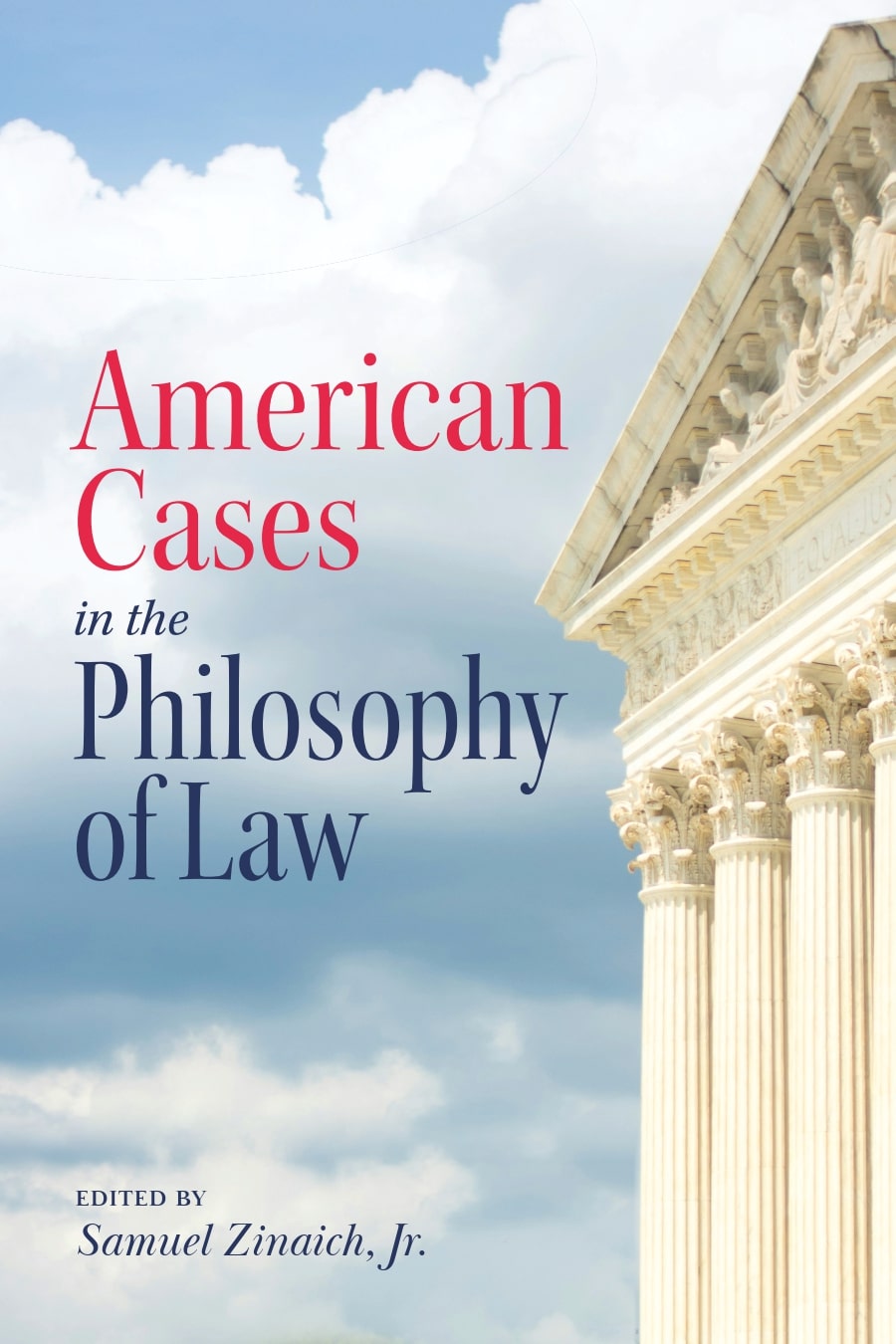
American Cases in the Philosophy of LawLow Cost
  • Publication Date: February 19, 2026
  • ISBN: 9781554816798 / 1554816793
  • 300 pages; 6" x 9"

Price for your region

Note on pricing.

Request Exam Copy

Examination copy policy

Availability: Worldwide

American Cases in the Philosophy of LawLow Cost

  • Publication Date: February 19, 2026
  • ISBN: 9781554816798 / 1554816793
  • 300 pages; 6" x 9"

This book brings together 64 of the most important, influential, and interesting cases in American law. These cases have been selected due to not only their legal and cultural significance but also their anticipated philosophical import. A wide range of themes and topics are represented, from free speech to race relations to criminal punishment. Each case has been carefully excerpted so as to focus attention on the features that illustrate the central principles and forms of judicial reasoning. Important contextualizing information is also provided to clarify each case’s historical setting as well as any relevant philosophical arguments and questions.

Comments

“Samuel Zinaich has produced an immensely valuable book for students and instructors who are looking for a distinctively philosophical approach to the study of law. The text provides a rich array of topics, thoughtfully arranged. By emphasizing recent case law, Zinaich’s text shows how significant legal-philosophical debates are to contemporary American life.” — Linda Radzik, Texas A&M University

“Professor Zinaich has created an ideal text for undergraduate courses in philosophy, law, and politics. His volume emphasizes the ethical, historical, and interpretive arguments driving Supreme Court opinions across diverse areas of law and public policy. The closely edited case excerpts and incisive questions about theoretical and practical implications will inspire active class discussion about fundamental constitutional, moral, and philosophical debates.” — Frank J. Colucci, Purdue University Northwest

Contents

Additional Thematic Groupings

Preface

Introduction

A Note to Instructors

Part 1: The U.S. Constitution

The Legislative Branch (Article I)

  • Wickard v. Filburn, 317 U.S. 111 (1942)
  • Printz v. United States, 521 U.S. 898 (1997)
  • United States v. Morrison, 529 U.S. 598 (2000)
  • United States v. Comstock, 560 U.S. 126 (2010)
  • Murphy v. National Collegiate Athletic Association, 584 U.S. 453 (2018)

The Executive Branch (Article II)

  • Humphrey’s Executor v. United States, 295 U.S. 602 (1935)
  • United States v. Nixon, 418 U.S. 683 (1974)
  • Clinton v. Jones, 520 U.S. 681 (1997)
  • Trump v. Vance, 591 U.S. 786 (2020)
  • Trump v. United States, 603 U.S. 593 (2024)
  • Loper Bright Enterprises v. Raimondo, 603 U.S. 369 (2024)

The Judicial Branch (Article III)

  • Marbury v. Madison, 5 U.S. 137 (1803)
  • Ex parte McCardle, 74 U.S. 506 (1869)
  • Lujan v. Defenders of Wildlife, 504 U.S. 555 (1992)
  • DeShaney v. Winnebago County Department of Social Services, 489 U.S. 189 (1989)

Part 2: Reproductive and Familial Rights

Reproductive Rights

  • Griswold v. Connecticut, 381 U.S. 479 (1965)
  • Roe v. Wade, 410 U.S. 113 (1973)
  • Planned Parenthood of Southeastern Pa. v. Casey, 505 U.S. 833 (1992)
  • Whole Woman’s Health v. Hellerstedt, 579 U.S. 582 (2016)
  • Dobbs v. Jackson Women’s Health Organization, 597 U.S. 215 (2022)

Familial Rights

  • Loving v. Virginia, 388 U.S. 1 (1967)
  • Washington v. Glucksberg, 521 U.S. 702 (1997)
  • Troxel v. Granville, 530 U.S. 57 (2000)
  • Lawrence v. Texas, 539 U.S. 558 (2003)
  • Obergefell v. Hodges, 576 U.S. 644 (2015)

Part 3: The Right to Free Speech

  • Roth v. United States, 354 U.S. 476 (1957)
  • New York Times v. Sullivan, 376 U.S. 254 (1964)
  • Miller v. California, 413 U.S. 15 (1973)
  • Hustler Magazine v. Falwell, 485 U.S. 46 (1988)
  • Mahanoy Area School District v. B. L., 594 U.S. 180 (2021)
  • 303 Creative LLC v. Elenis, 600 U.S. 570 (2023)

Part 4: The Right to Keep and Bear Arms

  • District of Columbia v. Heller, 554 U.S. 570 (2008)
  • McDonald v. City of Chicago, 561 U.S. 742 (2010)
  • Caetano v. Massachusetts, 577 U.S. 411 (2016)
  • New York State Rifle & Pistol Association, Inc. v. Bruen, 597 U.S. 1 (2022)
  • Garland v. Cargil, 602 U.S. 406 (2024)
  • United States v. Rahimi, 602 U.S. 680 (2024)

Part 5: The Right to Equality (Discrimination and Race Relations)

Discrimination

  • Plessy v. Ferguson, 163 U.S. 537 (1896)
  • Brown v. Board of Education of Topeka, 347 U.S. 483 (1954)
  • Batson v. Kentucky, 476 U.S. 79 (1986)
  • Foster v. Chatman, 578 U.S. 488 (2016)
  • Bostock v. Clayton County, 590 U.S. 644 (2020)

Race Relations

  • Regents of the University of California v. Bakke, 438 U.S. 265 (1978)
  • Grutter v. Bollinger, 539 U.S. 306 (2003)
  • Students for Fair Admissions, Inc. v. President and Fellows of Harvard College, 600 U.S. 181 (2023)

Part 6: War and International Affairs

  • Korematsu v. United States, 323 US 214 (1944)
  • Boumediene v. Bush, 553 U.S. 723 (2008)
  • Zivotofsky v. Kerry, 576 U.S. 1 (2015)
  • Puerto Rico v. Sanchez-Valle, 579 U.S. 59 (2016)
  • Trump v. Hawai’i, 585 U.S. 667 (2018)
  • A. A. R. P. v. Trump, 605 U.S. 91 (2025)

Part 7: Native American Tribes

  • United States v. Bryant, 579 U.S. 140 (2016)
  • United States v. Colley, 593 U.S. 345 (2021)
  • Oklahoma v. Castro-Huerta, 597 U.S. 629 (2022)
  • Haaland v. Brackeen, 599 U.S. 255 (2023)

Part 8: Crime and Punishment

Criminal Law

  • Burrage v. United States, 571 U.S. 204 (2014)
  • Rodriguez v. United States, 575 U.S. 348 (2015)
  • Carpenter v. United States, 585 U.S. 296 (2018)
  • Mitchell v. Wisconsin, 588 U.S. 840 (2019)
  • Counterman v. Colorado, 600 U.S. 66 (2023)

Punishment

  • Glossip v. Gross, 576 U.S. 863 (2015)
  • Hurst v. Florida, 577 U.S. 92 (2016)
  • Madison v. Alabama, 586 U.S. 265 (2019)
  • United States v. Tsarnaev, 595 U.S. 302 (2022)

Glossary

Additional Thematic Groupings

Gender and Sexuality

  • United States v. Morrison, 529 U.S. 598 (2000)
  • Griswold v. Connecticut, 381 U.S. 479 (1965)
  • Roe v. Wade, 410 U.S. 113 (1973)
  • Planned Parenthood of Southeastern Pa. v. Casey, 505 U.S. 833 (1992)
  • Whole Woman’s Health v. Hellerstedt, 579 U.S. 582 (2016)
  • Dobbs v. Jackson Women’s Health Organization, 597 U.S. 215 (2022)
  • Bostock v. Clayton County, 590 U.S. 644 (2020)

Nature and the Environment

  • Loper Bright Enterprises v. Raimondo, 603 U.S. 369 (2024)
  • Lujan v. Defenders of Wildlife, 504 U.S. 555 (1992)

Technology and Social Media

  • Mahanoy Area School District v. B. L., 594 U.S. 180 (2021)
  • Garland v. Cargil, 602 U.S. 406 (2024)
  • Carpenter v. United States, 585 U.S. 296 (2018)

The Constitution in Times of Crisis

  • Korematsu v. United States, 323 U.S. 214 (1944)
  • Boumediene v. Bush, 553 U.S. 723 (2008)
  • Zivotofsky v. Kerry, 576 U.S. 1 (2015)
  • Trump v. Hawai’i, 585 U.S. 667 (2018)
  • A. A. R. P. v. Trump, 605 U.S. 91 (2025)

The Individual and the State

  • Printz v. United States, 521 U.S. 898 (1997)
  • Murphy v. National Collegiate Athletic Association, 584 U.S. 453 (2018)
  • Griswold v. Connecticut, 381 U.S. 479 (1965)
  • Washington v. Glucksberg, 521 U.S. 702 (1997)
  • Lawrence v. Texas, 539 U.S. 558 (2003)
  • District of Columbia v. Heller, 554 U.S. 570 (2008)

Samuel Zinaich, Jr., is Associate Professor of Philosophy at Purdue University Northwest. He is author of Analytical Legal Naturalism (Lexington Books, 2020).

  • • 64 US Supreme Court rulings are included.
  • • Each case has been carefully excerpted to offer a concise presentation of only the features most significant to judicial interpretation and philosophy.
  • • Cases are grouped under several important themes, including: the US constitution; reproductive and familial rights; free speech; the right to bear arms; discrimination; race relations; international affairs; issues bearing on Native Americans; crime; and punishment.
  • • Includes an alternative thematic grouping of cases, covering topics such as gender, the environment, and technology.
  • • Begins with a general introduction to the function and interpretation of legal cases.
  • • Preceding each case is a brief contextualizing introduction and a description of the case’s philosophical implications.